By Tom Lasseter, McClatchy Newspapers
BAGHDAD, Iraq - Many of the Iraqi forces whom the U.S. is counting on to defeat Sunni Muslim insurgents, disarm Shiite Muslim gunmen and assume responsibility for keeping the peace have been infiltrated by sectarian militias and are plagued by incompetence and corruption.
Two weeks with American units that patrolled with Iraqi forces in west and east Baghdad found that Iraqi officers sold new uniforms meant for their troops, and that their soldiers wore plastic shower sandals while manning checkpoints, abused prisoners and solicited bribes to free suspects they'd captured.
Saturday, February 10, 2007


Friday, February 9, 2007
Council on Foreign Relations Recommends Withdrawal
...In a paper entitled "After the Surge: The Case for US Military Disengagement from Iraq", said troop levels are still too low to quell the fighting but more reinforcements would make little difference in any case. The US invasion "plunged the country into a civil war that brought about the deaths of tens of thousands of Iraqi civilians, wrecked the country's already debilitated infrastructure, and spurred violent sectarian rivalries." "The crisis has now moved beyond the capacity of Washington to control on its own... The United States lacks the military resources and the domestic and international political support to master the situation," Simon warned.
ROBERT FISK: IRAQI INSURGENTS OFFER PEACE FOR CONCESSIONS
For the first time, one of Iraq's principal insurgent groups has set out the terms of a ceasefire that would allow American and British forces to leave the country they invaded almost four years ago.
The present terms would be impossible for any US administration to meet - (and)...it clearly represents only the views of Sunni Muslim fighters. Shia militias are nowhere mentioned. The demands include the cancellation of the entire Iraqi constitution - almost certainly because the document, in effect, awards oil-bearing areas of Iraq to Shia and Kurds, but not to the minority Sunni community. Yet the Sunnis remain Washington's principal enemies in the Iraqi war.
There will, the group says, be no negotiations with Mr Maliki's government because they consider it "complicit in the slaughter of Iraqis by militias, the security apparatus and death squads". But they do call for the unity of Iraq and say they "do not recognise the divisions among the Iraqi people".
What is unclear, of course, is the degree to which al-Jeelani's statement represents the collective ideas of the Sunni insurgents. And, ominously, no mention is made of al-Qa'ida.
The present terms would be impossible for any US administration to meet - (and)...it clearly represents only the views of Sunni Muslim fighters. Shia militias are nowhere mentioned. The demands include the cancellation of the entire Iraqi constitution - almost certainly because the document, in effect, awards oil-bearing areas of Iraq to Shia and Kurds, but not to the minority Sunni community. Yet the Sunnis remain Washington's principal enemies in the Iraqi war.
There will, the group says, be no negotiations with Mr Maliki's government because they consider it "complicit in the slaughter of Iraqis by militias, the security apparatus and death squads". But they do call for the unity of Iraq and say they "do not recognise the divisions among the Iraqi people".
What is unclear, of course, is the degree to which al-Jeelani's statement represents the collective ideas of the Sunni insurgents. And, ominously, no mention is made of al-Qa'ida.
SHOOTING THE MESSENGER: COST OF MEDICAL CARE FOR INJURED VETERANS
Linda J. Bilmes, a lecturer in public policy at Harvard University, calls her latest paper “pretty dry.” That hasn’t prevented it from riling high-ranking Pentagon officials — who called her and her dean to complain about her work. When they questioned her sources of material, they ran into a bit of a problem: She did most of her research with data on federal Web sites. So what did the Pentagon do? It changed the Web sites, and now continues to trash her research.... While the Pentagon continues to attack, others in Washington are praising the paper.
The Iraq conflict is unusual.... in that so many soldiers are being injured out of combat. There are all kinds of reasons for that, he said, but it’s a reality.
“We think it’s reprehensible that the Pentagon would call Linda Bilmes and bitch her out over the phone and put pressure on the school” about this, Robinson said. “I want to ask the Department of Defense, ‘Why aren’t you doing reports on why there are so many injured and on their care?’ It’s ridiculous to be ignoring all of those [non-combat] injuries. Why are they attacking this research?”
The Iraq conflict is unusual.... in that so many soldiers are being injured out of combat. There are all kinds of reasons for that, he said, but it’s a reality.
“We think it’s reprehensible that the Pentagon would call Linda Bilmes and bitch her out over the phone and put pressure on the school” about this, Robinson said. “I want to ask the Department of Defense, ‘Why aren’t you doing reports on why there are so many injured and on their care?’ It’s ridiculous to be ignoring all of those [non-combat] injuries. Why are they attacking this research?”
Thursday, February 8, 2007
BAGHDAD CRACKDOWN & THE DECIDER QUESTIONED
BAGHDAD, Iraq (AP) - Baghdad's streets were electric with tension Wednesday as U.S. officials confirmed the new security operation was under way. U.S. armor rushed through streets, and Iraqi armored personnel carriers guarded bridges and major intersections....
In parts of the city only a few shops were open, a reminder of the fear people have of more car and suicide bombings, which have hit Baghdad with regularity in recent weeks.
Lines outside gas stations stretched for more than a mile, as the city is experiencing its worst fuel crisis in months. Supplies are very low because refining capacity is down, a problem compounded by hoarding....
The operation is the third attempt by Prime Minister Nouri al-Maliki and his U.S. backers to pacify Baghdad since the Shiite leader came to office in May. The operation, which will involve about 90,000 Iraqi and American troops, is seen by many as a last chance to curb Iraq's sectarian war.
Bush power trip jeopardizes terror war: BY DEWAYNE WICKHAM, Gannett News
....Whatever the reason, Bush is on a power trip that seems to be hurtling him - and this nation - toward a political abyss. Last week, in the face of growing congressional opposition to his plan to send an additional 21,500 troops to Iraq, the president said he wouldn't be deterred by such criticism. "I'm the decision-maker," he snapped.
Bush too often responds like a dictator when his actions are challenged. That kind of behavior doesn't sit well with many Democrats - and some Republicans.
http://news.enquirer.com/apps/pbcs.dll/article?AID=/20070207/EDIT02/702070304/1090/EDIT
In parts of the city only a few shops were open, a reminder of the fear people have of more car and suicide bombings, which have hit Baghdad with regularity in recent weeks.
Lines outside gas stations stretched for more than a mile, as the city is experiencing its worst fuel crisis in months. Supplies are very low because refining capacity is down, a problem compounded by hoarding....
The operation is the third attempt by Prime Minister Nouri al-Maliki and his U.S. backers to pacify Baghdad since the Shiite leader came to office in May. The operation, which will involve about 90,000 Iraqi and American troops, is seen by many as a last chance to curb Iraq's sectarian war.
Bush power trip jeopardizes terror war: BY DEWAYNE WICKHAM, Gannett News
....Whatever the reason, Bush is on a power trip that seems to be hurtling him - and this nation - toward a political abyss. Last week, in the face of growing congressional opposition to his plan to send an additional 21,500 troops to Iraq, the president said he wouldn't be deterred by such criticism. "I'm the decision-maker," he snapped.
Bush too often responds like a dictator when his actions are challenged. That kind of behavior doesn't sit well with many Democrats - and some Republicans.
http://news.enquirer.com/apps/pbcs.dll/article?AID=/20070207/EDIT02/702070304/1090/EDIT
Wednesday, February 7, 2007
COOKING THE INTELLIGENCE?: PENTAGON INSPECTOR GENERAL TO RELEASE INVESTIGATION FRIDAY

....Led by Feith, the group's members also included Larry Franklin, who pleaded guilty to leaking classified documents regarding Iran to a Washington-based Israeli lobby in 2005; prominent neoconservative and Iran-Contra intermediary Michael Ledeen; and Middle East expert Harold Rhode, who purportedly sought to purge the Pentagon of anyone opposing the group’s hawkish Iraq agenda.....
While the US intelligence community struggled to check a hawkish Executive Branch set on going to war, the OSP funneled questionable information directly to the White House, bypassing standard channels and operational procedures and deploying its own “off book teams” into the region without notifying special forces already on the ground.
ADDENDUM: LIES AND MORE LIES: HERE'S MORE FROM A FOLLOW UP INTERVIEW WITH DOUGLAS FEITH BY CHRIS WALLACE ON FEBRUARY 18, 2007
Chris Wallace: Now a followup to our interview last Sunday with former Defense Undersecretary Douglas Feith. Many of you wrote in asking us to check out Feith's claim that he's being unfairly accused of hyping the threat from Saddam Hussein. First, here's what he said to us.
Douglas Feith: Nobody in my office ever said there was an operational relationship between Iraq and al Qaeda. It's just not correct. I mean, words matter.
Wallace: But it turns out he did make that case in a memo he sent to the Senate Intelligence Committee in October of '03. The Weekly Standard, who saw the Feith memo, described it this way: 'Osama bin Laden and Saddam Hussein had an operational relationship from the early 1990s to 2003 that involved training in explosives and weapons of mass destruction, logistical support for terrorist attacks, al Qaeda training camps and safe haven in Iraq, and Iraqi financial support for al Qaeda.' Later, Vice President Cheney said the article was the best source of information on the Iraq-al Qaeda connection.
Douglas Feith: Nobody in my office ever said there was an operational relationship between Iraq and al Qaeda. It's just not correct. I mean, words matter.
Wallace: But it turns out he did make that case in a memo he sent to the Senate Intelligence Committee in October of '03. The Weekly Standard, who saw the Feith memo, described it this way: 'Osama bin Laden and Saddam Hussein had an operational relationship from the early 1990s to 2003 that involved training in explosives and weapons of mass destruction, logistical support for terrorist attacks, al Qaeda training camps and safe haven in Iraq, and Iraqi financial support for al Qaeda.' Later, Vice President Cheney said the article was the best source of information on the Iraq-al Qaeda connection.
IRAQ WAR LEGACY: VIOLENT CIVILIAN ATTACKS, KIDNAPPINGS AND DEATH SQUADS

Sadriya Image: ....twisted wrecks, burnt flesh, screaming faces, lacerated bodies, smoke and flames. The images so terribly familiar now, they blur into each other. If we are to cover Iraq properly, the violence is bound to dominate. On the other hand, you could argue we don't do a very good job at it. There is an average of 800-900 violent incidents reported each week - shootings, kidnappings, mortar and rocket attacks, roadside bombs, car bombings.
We can only report on a handful of these. So inevitably, the focus often ends up being on the biggest attacks. It's something we're not always comfortable with in the bureau. We had the dilemma again with the weekend attack on the Sadriya market, when the news agencies billed it as the worst single bombing since the invasion.
It was - from one blast. But in November 2006 more than 200 people died and another 400 were injured in an attack in Baghdad's Sadr City. It was a single incident, but it involved several bombs and mortars.
In other words, through a common journalistic device - first, worst, biggest - there is a risk of obscuring the wider truth of the level of violence.
In the weeks before the Sadriya attack, there had been several other massive car bombings each one of which killed more than 70 people , as well as the usual harvest of death squad victims dumped around the city....
It was - from one blast. But in November 2006 more than 200 people died and another 400 were injured in an attack in Baghdad's Sadr City. It was a single incident, but it involved several bombs and mortars.
In other words, through a common journalistic device - first, worst, biggest - there is a risk of obscuring the wider truth of the level of violence.
In the weeks before the Sadriya attack, there had been several other massive car bombings each one of which killed more than 70 people , as well as the usual harvest of death squad victims dumped around the city....
Monday, February 5, 2007
OFFICERS WITH PHD'S ADVISING WAR EFFORT
By Thomas E. Ricks Washington Post Staff Writer Monday, February 5, 2007 Gen. David H. Petraeus, the new U.S. commander in Iraq, is assembling a small band of warrior-intellectuals....in an eleventh-hour effort to reverse the downward trend in the Iraq war....But there is widespread skepticism that even this unusual group, with its specialized knowledge of counterinsurgency methods, will be able to win the battle of Baghdad.
Many military insiders are skeptical that the extra brainpower ultimately will make much difference, or that lessons learned by McMaster in Tall Afar or Petraeus in Mosul will be easily applied in the far larger arena of Baghdad.
..., experts agree that the basic problem in Iraq is political, not military, and that although a military campaign can create a breathing space for politicians, it cannot by itself reverse the dynamic driving Iraqis to fight a civil war.
...As the U.S.-designed campaign to bring security to Baghdad unfolds, Petraeus's chief economic adviser, Col. Michael J. Meese, will coordinate security and reconstruction efforts, trying to ensure that "build" follows the "clear" and "hold" phases of action. Meese also holds a PhD from Princeton, where he studied how the Army historically handled budget cuts. ....his chief adviser on counterinsurgency operations an outspoken officer in the Australian Army. Lt. Col. David Kilcullen holds a PhD in anthropology, for which he studied Islamic extremism in Indonesia. ....Among Kilcullen's dictums: "Rank is nothing: talent is everything" -- a subversive thought in an organization as hierarchical as the U.S. military....Beyond.... senior officers is a larger ring of advisers whose views already are shaping planning for the coming operation in Baghdad.
A Different Arena
Many military insiders are skeptical that the extra brainpower ultimately will make much difference, or that lessons learned by McMaster in Tall Afar or Petraeus in Mosul will be easily applied in the far larger arena of Baghdad.
..., experts agree that the basic problem in Iraq is political, not military, and that although a military campaign can create a breathing space for politicians, it cannot by itself reverse the dynamic driving Iraqis to fight a civil war.
ASSAD: I CAN HELP--WHAT'S THE BENEFIT OF DEMOCRACY IF YOU'RE DEAD?
 Assad...(Americans) are responsible for the political situation and they haven't embarked any policy inside Iraq here. They only talk about sending more troops or less troops. They only talk about troops and power, not about political process.
Sawyer: Because Americans would say they voted, they now have the beginning of democracy there.
Assad: What's the benefit of democracy if you're dead? Now after the war, more than 700,000 Iraqis were killed. So is it democracy for killing or for having better standard of life? For starvation? For insecurity? For all this? So democracy is a tool to have a better life.
Sawyer: What would happen? Then talks take place.
Assad: Yeah.
Sawyer: You, Iran, the neighboring countries?
Assad: Yeah.
Sawyer: So the influence of the neighboring countries can create a cease-fire?
Assad: Yes, this is something mainly that they don't understand. It doesn't matter how strong economically or what army you have, it's a matter of credibility. We have credibility. We have good relations with the other factions. They should trust you to be able to play a role.
We have this good relations with all the parties, including the parties participating in this government and the other who oppose this political process. So that's how we can help. As Syria. Maybe other countries as well.
We have this good relations with all the parties, including the parties participating in this government and the other who oppose this political process. So that's how we can help. As Syria. Maybe other countries as well.
Sunday, February 4, 2007
VIEWS OF IRAN'S INVOLVEMENT: US VS. IRAQI
BAGHDAD, Feb 4 (KUNA) -- Iraqi President Jalal Al-Talabani on Sunday said that Iranians expressed readiness to cooperate with the Iraqi authorities and the local American military command to implement a new security plan in the country...."I've sensed on their part understanding of the conditions in Iraq and I believe that they have exerted tremendous and successful efforts with the armed militias accused of involvement in terrorist acts," the president said. "The Iranians have stood on our side since the first days of the liberation as they have backed the liberation and the ruling council and the elections and the Iraqi constitution," he said.
INTELLIGENCE COMMUNITY PLAYS DOWN IRAN'S ROLE IN IRAQ: 2/4/07 ....The U.S. government's data, however, show that Sunni insurgents, not Shiite militias supported by Iran, have been responsible for most American combat deaths...."The vast majority of Americans who are being killed are still being killed by IEDs [improvised explosive devices] set by Sunnis," said Kenneth Pollack, a former CIA and White House expert on Persian Gulf affairs. "The administration is between a rock and a hard place here," said a senior U.S. intelligence official, speaking anonymously because the intelligence on Iran is highly classified. "On one hand, they have to convince people here and abroad that this time they're telling the truth and they've got the goods, which won't be easy. And a lot of our friends in the region, like the Saudis and the Israelis and the Lebanese, are nervous and want us to get tough with Iran." ....Intelligence officials said they have strong evidence of Iranian support for Iraqi Shiite militias, especially the Mahdi Army. The question is how great a role they're playing in the conflict....weapons include shaped-charge explosives capable of breaching advanced armor, armor-piercing rocket-propelled grenades and Katyusha rockets, the senior U.S. intelligence official said....Iran's motives remain murky, he said.
"Are the Iranians mucking around in Iraq? You bet," he said. "Do they want to make sure they've got a government in Baghdad that's simpatico instead of another war? Yep. But are they fighting a secret war against the Americans in Iraq? We have no evidence of that." http://seattletimes.nwsource.com/html/nationworld/2003555705_usiran04.html
INTELLIGENCE COMMUNITY PLAYS DOWN IRAN'S ROLE IN IRAQ: 2/4/07 ....The U.S. government's data, however, show that Sunni insurgents, not Shiite militias supported by Iran, have been responsible for most American combat deaths...."The vast majority of Americans who are being killed are still being killed by IEDs [improvised explosive devices] set by Sunnis," said Kenneth Pollack, a former CIA and White House expert on Persian Gulf affairs. "The administration is between a rock and a hard place here," said a senior U.S. intelligence official, speaking anonymously because the intelligence on Iran is highly classified. "On one hand, they have to convince people here and abroad that this time they're telling the truth and they've got the goods, which won't be easy. And a lot of our friends in the region, like the Saudis and the Israelis and the Lebanese, are nervous and want us to get tough with Iran." ....Intelligence officials said they have strong evidence of Iranian support for Iraqi Shiite militias, especially the Mahdi Army. The question is how great a role they're playing in the conflict....weapons include shaped-charge explosives capable of breaching advanced armor, armor-piercing rocket-propelled grenades and Katyusha rockets, the senior U.S. intelligence official said....Iran's motives remain murky, he said.
"Are the Iranians mucking around in Iraq? You bet," he said. "Do they want to make sure they've got a government in Baghdad that's simpatico instead of another war? Yep. But are they fighting a secret war against the Americans in Iraq? We have no evidence of that." http://seattletimes.nwsource.com/html/nationworld/2003555705_usiran04.html
IRAQI ARMY FINDS MORTARS BURIED IN SAND

Iraqi Army and Multi-National Division – Baghdad Soldiers uncovered more than 1,100 81mm high-explosive mortar rounds at a cache near the main highway, Route Tampa, leading into the Iraqi capital Feb. 3.
Saturday, February 3, 2007
2/2/07 RELEASE: NATIONAL INTELLIGENCE ESTIMATE:
READ IT HERE (EXCERPT)
Iraqi society’s growing polarization, the persistent weakness of the security forces and the state in general, and all sides’ ready recourse to violence are collectively driving an increase in communal and insurgent violence and political extremism....even if violence is diminished, given the current winner-take-all attitude and sectarian animosities infecting the political scene, Iraqi leaders will be hard pressed to achieve sustained political reconciliation in the time frame of this estimate. The challenges confronting Iraqis are daunting, and multiple factors are driving the current trajectory of the country’s security and political evolution.
Decades of subordination to Sunni political, social, and economic domination have made the Shia deeply insecure about their hold on power. This insecurity leads the Shia to mistrust U.S. efforts to reconcile Iraqi sects and reinforces their unwillingness to engage with the Sunnis on a variety of issues, including adjusting the structure of Iraq’s federal system, reining in Shia militias, and easing de-Baathification.
Many Sunni Arabs remain unwilling to accept their minority status, believe the central government is illegitimate and incompetent, and are convinced that Shia dominance will increase Iranian influence over Iraq, in ways that erode the state’s Arab character and increase Sunni repression.
The absence of unifying leaders among the Arab Sunni or Shia with the capacity to speak for or exert control over their confessional groups limits prospects for reconciliation. The Kurds remain willing to participate in Iraqi state-building but reluctant to surrender any of the gains in autonomy they have achieved.
The Kurds are moving systematically to increase their control of Kirkuk to guarantee annexation of all or most of the city and province into the Kurdistan Regional Government (K.R.G.) after the constitutionally mandated referendum scheduled to occur no later than 31 December 2007. Arab groups in Kirkuk continue to resist violently what they see as Kurdish encroachment.
Despite real improvements, the Iraqi Security Forces (I.S.F.) — particularly the Iraqi police — will be hard pressed in the next 12-18 months to execute significantly increased security responsibilities, and particularly to operate independently against Shia militias with success. Sectarian divisions erode the dependability of many units, many are hampered by personnel and equipment shortfalls, and a number of Iraqi units have refused to serve outside of the areas where they were recruited.
Extremists — most notably the Sunni jihadist group Al Qaeda in Iraq (A.Q.I.) and Shia oppositionist Jaysh al-Mahdi (J.A.M.) — continue to act as very effective accelerators for what has become a self-sustaining inter-sectarian struggle between Shia and Sunnis.
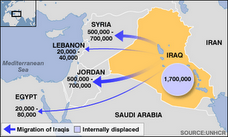
Significant population displacement, both within Iraq and the movement of Iraqis into neighboring countries, indicates the hardening of ethno-sectarian divisions, diminishes Iraq’s professional and entrepreneurial classes, and strains the capacities of the countries to which they have relocated. The U.N. estimates over a million Iraqis are now in Syria and Jordan.
The Intelligence Community judges that the term “civil war” does not adequately capture the complexity of the conflict in Iraq, which includes extensive Shia-on-Shia violence, Al Qaeda and Sunni insurgent attacks on coalition forces, and widespread criminally motivated violence. Nonetheless, the term “civil war” accurately describes key elements of the Iraqi conflict, including the hardening of ethno-sectarian identities, a sea change in the character of the violence, ethno-sectarian mobilization, and population displacements.
Iraqi society’s growing polarization, the persistent weakness of the security forces and the state in general, and all sides’ ready recourse to violence are collectively driving an increase in communal and insurgent violence and political extremism....even if violence is diminished, given the current winner-take-all attitude and sectarian animosities infecting the political scene, Iraqi leaders will be hard pressed to achieve sustained political reconciliation in the time frame of this estimate. The challenges confronting Iraqis are daunting, and multiple factors are driving the current trajectory of the country’s security and political evolution.
Decades of subordination to Sunni political, social, and economic domination have made the Shia deeply insecure about their hold on power. This insecurity leads the Shia to mistrust U.S. efforts to reconcile Iraqi sects and reinforces their unwillingness to engage with the Sunnis on a variety of issues, including adjusting the structure of Iraq’s federal system, reining in Shia militias, and easing de-Baathification.
Many Sunni Arabs remain unwilling to accept their minority status, believe the central government is illegitimate and incompetent, and are convinced that Shia dominance will increase Iranian influence over Iraq, in ways that erode the state’s Arab character and increase Sunni repression.
The absence of unifying leaders among the Arab Sunni or Shia with the capacity to speak for or exert control over their confessional groups limits prospects for reconciliation. The Kurds remain willing to participate in Iraqi state-building but reluctant to surrender any of the gains in autonomy they have achieved.
The Kurds are moving systematically to increase their control of Kirkuk to guarantee annexation of all or most of the city and province into the Kurdistan Regional Government (K.R.G.) after the constitutionally mandated referendum scheduled to occur no later than 31 December 2007. Arab groups in Kirkuk continue to resist violently what they see as Kurdish encroachment.
Despite real improvements, the Iraqi Security Forces (I.S.F.) — particularly the Iraqi police — will be hard pressed in the next 12-18 months to execute significantly increased security responsibilities, and particularly to operate independently against Shia militias with success. Sectarian divisions erode the dependability of many units, many are hampered by personnel and equipment shortfalls, and a number of Iraqi units have refused to serve outside of the areas where they were recruited.
Extremists — most notably the Sunni jihadist group Al Qaeda in Iraq (A.Q.I.) and Shia oppositionist Jaysh al-Mahdi (J.A.M.) — continue to act as very effective accelerators for what has become a self-sustaining inter-sectarian struggle between Shia and Sunnis.
Significant population displacement, both within Iraq and the movement of Iraqis into neighboring countries, indicates the hardening of ethno-sectarian divisions, diminishes Iraq’s professional and entrepreneurial classes, and strains the capacities of the countries to which they have relocated. The U.N. estimates over a million Iraqis are now in Syria and Jordan.
The Intelligence Community judges that the term “civil war” does not adequately capture the complexity of the conflict in Iraq, which includes extensive Shia-on-Shia violence, Al Qaeda and Sunni insurgent attacks on coalition forces, and widespread criminally motivated violence. Nonetheless, the term “civil war” accurately describes key elements of the Iraqi conflict, including the hardening of ethno-sectarian identities, a sea change in the character of the violence, ethno-sectarian mobilization, and population displacements.
Friday, February 2, 2007
One Child in Iraq (UN) & Refugee Crisis (per The Independent)
"I’m 11 years old and an only son. I’m a pupil at Mansour Primary School in Baghdad. Lately, I have been feeling very lonely in my class. This week, I was the only student in class because all my classmates didn’t come to school for various reasons. “Since last September, three of my classmates have been kidnapped and two have been killed. One was murdered with his family at home and the other was a victim of a bomb explosion a month ago." Iraqis abandon their homes in Middle East's new refugee exodus They flee because they fear for their lives. Some 3,000 Iraqis are being killed every month according to the UN. Most come from Baghdad and the centre of the country, but all of Iraq outside the three Kurdish provinces in the north is extremely violent. A detailed survey by the International Organisation for Migration on displacement within Iraq said that most people move after direct threats to their lives: "These threats take the form of abductions; assassinations of individuals or their families." There are fewer mixed areas left in Iraq. In Baghdad, militias now feel free to use mortars to bombard each other knowing that they will not hit members of their own community. Shia and Sunni both regard themselves as victims responding to provocation. The most common destinations are Jordan and Syria which have taken 1.6 million people. At first it was the better-off who fled, including half of Iraq's 34,000 doctors. Now it is the poor who are arriving in Amman and Damascus with little means of surviving. Only Syria has formally recognised a need for temporary protection for Iraqis. Others, including the US and UK, are loath to admit that one of the world's great man-made disasters is taking place. The UNHCR thinks every Iraqi should qualify as a refugee because of the extraordinary level of violence in the country. "This is the fastest-growing refugee crisis in the world," Kenneth Bacon, president of Refugees International told the US Senate Judiciary Committee. …. For Sunni there is no real place of safety in Iraq. In Baghdad they are being squeezed into smaller and smaller areas. Cities like Ramadi and Fallujah are partly ruined and very dangerous. Mohammed Sahib Ali, 48, a government employee, was forced out of the al-Hurriyah area by Shia militiamen. A Sunni, he took refuge in a school in Salah ad-Din province. "We are dying here," said Ali. "Not enough food, not enough medicines. I can't go to work and my three sons can't attend their classes. We don't know what to do." http://news.independent.co.uk/world/middle_east/article2204094.ece
Thursday, February 1, 2007
WHO'S ON FIRST?
...al-Sadr's militias ...heavily infiltrated the Iraqi police and army units that they've trained and armed.
"Half of them are JAM. They'll wave at us during the day and shoot at us during the night," said 1st Lt. Dan Quinn, a platoon leader in the Army's 1st Infantry Division, using the initials of the militia's Arabic name, Jaish al Mahdi. "People (in America) think it's bad, but that we control the city. That's not the way it is. They control it, and they let us drive around. It's hostile territory." Al-Sadr's success in infiltrating Iraqi security forces says much about the continued inability of American commanders in Iraq to counter the classic insurgent tactic of using popular support to trump superior military firepower. Lacking attack helicopters and other sophisticated weapons, al-Sadr's men have expanded their empire with borrowed trucks and free lunches for militiamen
"Half of them are JAM. They'll wave at us during the day and shoot at us during the night," said 1st Lt. Dan Quinn, a platoon leader in the Army's 1st Infantry Division, using the initials of the militia's Arabic name, Jaish al Mahdi. "People (in America) think it's bad, but that we control the city. That's not the way it is. They control it, and they let us drive around. It's hostile territory." Al-Sadr's success in infiltrating Iraqi security forces says much about the continued inability of American commanders in Iraq to counter the classic insurgent tactic of using popular support to trump superior military firepower. Lacking attack helicopters and other sophisticated weapons, al-Sadr's men have expanded their empire with borrowed trucks and free lunches for militiamen
KISSINGER, ALBRIGHT WEIGH IN ON IRAQ
BARRY SCHWEID,Associated Press
WASHINGTON - Former Secretaries of State Henry Kissinger and Madeleine Albright urged President Bush on Wednesday ...to develop a comprehensive strategy for the area. They called for wide-ranging talks with Iraq's neighbors, including Iran and Syria, and increased autonomy for clashing Iraqi groups. The administration has brushed aside the proposal to engage Syria and Iran.
Kissinger...said...."I think the focus has been on the surge," he testified. "My focus is the other way around: to explain the surge in terms of the strategy to which we should go."...a strategy that would permit large regional autonomy for the various Iraqi groups and a stronger Iraqi army. And, he said, "All of this has to be in the context of a willingness to talk to Iran" because of its power, even though he did not think Iran "would help us in Iraq as such." "What we cannot accept is an Iran that seeks to dominate the region," Kissinger said.
Albright, who was secretary of state under President Clinton, ...told the committee, "We are viewed in the Middle East as a colonial power and our motives are suspect." Like Kissinger, she supported participation by Iran and Syria along with other nations in talks designed to keep Iraq from slipping into chaos. "One gains by communicating with countries with which one disagrees," Albright said. Kissinger said the U.S. should always be ready to negotiate with governments with which it disagrees.
The Iraq Study Group, a private panel headed by former Secretary of State James A. Baker III and former Rep. Lee Hamilton, D-Ind., recommended in December that the administration engage in talks with Iran and Syria.
WASHINGTON - Former Secretaries of State Henry Kissinger and Madeleine Albright urged President Bush on Wednesday ...to develop a comprehensive strategy for the area. They called for wide-ranging talks with Iraq's neighbors, including Iran and Syria, and increased autonomy for clashing Iraqi groups. The administration has brushed aside the proposal to engage Syria and Iran.
Kissinger...said...."I think the focus has been on the surge," he testified. "My focus is the other way around: to explain the surge in terms of the strategy to which we should go."...a strategy that would permit large regional autonomy for the various Iraqi groups and a stronger Iraqi army. And, he said, "All of this has to be in the context of a willingness to talk to Iran" because of its power, even though he did not think Iran "would help us in Iraq as such." "What we cannot accept is an Iran that seeks to dominate the region," Kissinger said.
Albright, who was secretary of state under President Clinton, ...told the committee, "We are viewed in the Middle East as a colonial power and our motives are suspect." Like Kissinger, she supported participation by Iran and Syria along with other nations in talks designed to keep Iraq from slipping into chaos. "One gains by communicating with countries with which one disagrees," Albright said. Kissinger said the U.S. should always be ready to negotiate with governments with which it disagrees.
The Iraq Study Group, a private panel headed by former Secretary of State James A. Baker III and former Rep. Lee Hamilton, D-Ind., recommended in December that the administration engage in talks with Iran and Syria.
Subscribe to:
Posts (Atom)