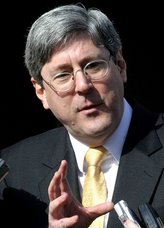
GEN. WESLEY CLARK: Well, in a way. But, you know, history doesn’t repeat itself exactly twice. What I did warn about when I testified in front of Congress in 2002, I said if you want to worry about a state, it shouldn’t be Iraq, it should be Iran. But this government, our administration, wanted to worry about Iraq, not Iran.
I knew why, because I had been through the Pentagon right after 9/11. About ten days after 9/11, I went through the Pentagon and I saw Secretary Rumsfeld and Deputy Secretary Wolfowitz. I went downstairs just to say hello to some of the people on the Joint Staff who used to work for me, and one of the generals called me in. He said, “Sir, you’ve got to come in and talk to me a second.” I said, “Well, you’re too busy.” He said, “No, no.” He says, “We’ve made the decision we’re going to war with Iraq.” This was on or about the 20th of September. I said, “We’re going to war with Iraq? Why?” He said, “I don’t know.” He said, “I guess they don’t know what else to do.” So I said, “Well, did they find some information connecting Saddam to al-Qaeda?” He said, “No, no.” He says, “There’s nothing new that way. They just made the decision to go to war with Iraq.” He said, “I guess it’s like we don’t know what to do about terrorists, but we’ve got a good military and we can take down governments.” And he said, “I guess if the only tool you have is a hammer, every problem has to look like a nail.”
So I came back to see him a few weeks later, and by that time we were bombing in Afghanistan. I said, “Are we still going to war with Iraq?” And he said, “Oh, it’s worse than that.” He reached over on his desk. He picked up a piece of paper. And he said, “I just got this down from upstairs” -- meaning the Secretary of Defense’s office -- “today.” And he said, “This is a memo that describes how we’re going to take out seven countries in five years, starting with Iraq, and then Syria, Lebanon, Libya, Somalia, Sudan and, finishing off, Iran.” I said, “Is it classified?” He said, “Yes, sir.” I said, “Well, don’t show it to me.” And I saw him a year or so ago, and I said, “You remember that?” He said, “Sir, I didn’t show you that memo! I didn’t show it to you!”
Thursday, March 8, 2007


Wednesday, March 7, 2007
Iraq’s Draft Petroleum Law: Two Perspectives
(this) paper was presented by Tariq Shafiq at a conference for Iraqi oil technocrats in 'Amman on 17 February. Mr Shafiq, a principal drafter of the petroleum law, is director of Petrolog & Associates, Chair Fertile Crescent Oil Company, and a former Executive Director and Vice Chairman of Iraq National Oil Company....
Iraq may prove to have one of the largest petroleum resource bases in the world, with potential oil reserves in excess of 215bn barrels and proven reserves in the region of 115bn barrels, which puts it on par with Saudi Arabia. Moreover, its exploration and development costs are amongst the lowest in the Middle East....
The law is investment friendly. It encourages private enterprise and welcomes international oil companies (IOCs) to work in partnership with the Iraq National Oil Company (INOC). The IOCs have a recognized role to play in the transfer of up-to-date state-of-the-art technology, the technical and managerial training of Iraqis, and in providing investment capital.
The third draft also stipulates that oil and gas exploration and development programs need to be distributed geographically. However, while social justice may require this, nature unfortunately does not, as oil and gas are not equally distributed in all the provinces. The checks and balances in the third draft are now insufficient to cope with Iraq’s internal political complications, leaving the jurisdiction of the authorities and the processes for granting rights open to political manipulation....
.... Further, and critically for the future of Iraq’s oil and gas industry, the draft would shift balance of power in the management of Iraq’s oil and gas resource alarmingly from the center to the regions. .... The critical items that have been removed in the third draft are fundamental to professionalism, transparency and accountability. The principles are still there, but the mechanisms for enforcing them in Iraq’s current turbulent situation have been removed or circumvented.
Iraqi Oil Law Gives Cover for Corporate Profit
By Emad Mekay, IPS News. http://www.alternet.org/waroniraq/48605/
The U.S.-backed Iraqi cabinet approved a new oil law Monday that is set to give foreign companies the long-term contracts and safe legal framework they have been waiting for, but which has rattled labour unions and international campaigners who say oil production should remain in the hands of Iraqis. For example, it specifies that up to two-thirds of Iraq's known reserves would be developed by multinationals, under contracts lasting for 15 to 20 years.
This policy would represent a u-turn for Iraq's oil industry, which has been in the public sector for more than three decades, and would break from normal practice in the Middle East.
According to local labour leaders, transferring ownership to the foreign companies would give a further pretext to continue the U.S. occupation on the grounds that those companies will need protection.
Union leaders have complained that they, along with other civil society groups, were left out of the drafting process despite U.S. claims it has created a functioning democracy in Iraq.
Under the production-sharing agreements provided for in the draft law, companies will not come under the jurisdiction of Iraqi courts in the event of a dispute, nor to the general auditor.
The ownership of the oil reserves under this draft law will remain with the state in form, but not in substance, critics say.
Sunday, March 4, 2007
US ARRESTS 500+ IRANIANS IN IRAQ
U.S. Has Arrested More Than 500 Iranians In Iraq And Pursued Others Into Iran
By Sherwood Ross
The Cold War between the U.S. and Iran is heating up.
U.S. military and special-operations teams "have escalated their activities in Iran to gather intelligence" and reportedly "have also crossed the border in pursuit of Iranian operatives from Iraq," according to investigative reporter Seymour Hersh in an article in the March 5 issue of "The New Yorker" magazine.
"The U.S. military also has arrested and interrogated hundreds or Iranians in Iraq," Hersh reported, including humanitarian aid workers mistakenly scooped up and released after interrogation.
Hersh quotes a former senior intelligence aide stating: "The word went out last August for the military to snatch as many Iranians in Iraq as they can. They had five hundred locked up at one time. We're working these guys and getting information from them."
The intelligence source added, "The White House goal is to build a case that the Iranians have been fomenting the insurgency and they've been doing it all along--- that Iran is, in fact, supporting the killing of Americans."
WAR AND INSURGENCY CONTINUES IN IRAQ

NEW YORK TIMES:
IN BAGHDAD SECTARIAN LINES TOO DEADLY TO CROSS
BAGHDAD, March 3 — After centuries full of vibrant interaction, of marrying, sharing and selling across sects and classes, Baghdad has become a capital of corrosive and violent borderlines. Streets never crossed. Conversations never started. Doors never entered.
Sunnis and Shiites in many professions now interact almost exclusively with colleagues of the same sect. Sunnis say they are afraid to visit hospitals because Shiites loyal to the cleric Moktada al-Sadr run the Health Ministry, while Shiite laborers who used to climb into the back of pickup trucks for work across the Tigris River in Sunni western Baghdad now take jobs only near home.
Sybaa Street used to be wall-to-wall people: sidewalks were crammed with shoppers, and roads were snarled with cars. In the heart of central Baghdad, Sybaa was known as the road to get from the automotive shops on one side of the market district to the hardware stores on the other. Back then — as recently as two years ago, residents said — no one seemed to care that it was the border between the mostly Sunni neighborhood of Fadhil and the largely Shiite areas to the south, Sadriya and Sheik Omar.
But that has all changed. After six months of fighting between Sunnis and Shiites, Sybaa Street is now deserted and forsaken. On a recent afternoon, the only sign of life was a lone mechanic working inside a dark garage, his efforts lighted by a single bulb. Bullets from earlier battles punctured nearly everything — buildings, utility poles, even rusted mufflers hanging outside shuttered shops.
Um Shaima, 48, a garrulous Sunni widow who used to sell yogurt in the Sadriya market, lives just north of Sybaa Street in Fadhil. She said she used to visit the stores there for clothes. Her cousin Samir worked for years on the Sadriya side of Sybaa Street as a mechanic without any trouble.
Then a few months ago, Ms. Shaima said, he received a threat. “They told him, ‘You are a Sunni, and all Sunnis are infidels and their women are prostitutes, so stop coming to Sadriya or you will be killed,’ ” she said.
“He didn’t listen,” she added. The next day, he was kidnapped. Witnesses said Shiite militants yanked him off his motorcycle and threw him in the trunk of a sedan. “They called his wife at 9 a.m. the next day,” Ms. Shaima said, “telling her that they will kill all the Sunnis, and your husband is dead.”
“He didn’t listen,” she added. The next day, he was kidnapped. Witnesses said Shiite militants yanked him off his motorcycle and threw him in the trunk of a sedan. “They called his wife at 9 a.m. the next day,” Ms. Shaima said, “telling her that they will kill all the Sunnis, and your husband is dead.”
Insurgents strike as Iraq vows to avenge slain cops and March 10 conference is planned published: Saturday March 3, 2007:
http://rawstory.com/news/afp/Insurgents_strike_as_Iraq_vows_to_a_03032007.html
A suicide car bomber killed 12 people in an attack on a checkpoint in western Iraq on Saturday, as the embattled government vowed to avenge the murder of 14 kidnapped policemen. South of Baghdad, suspected members of another Sunni faction shot dead six men who dared to attend local reconciliation talks between Sunnis and Shiites.
Shortly afterwards, a coalition of insurgent groups led by Al-Qaeda said in an Internet message that the hostages would be killed to avenge the alleged rape of a Baghdad Sunni woman by Shiite police. Late on Friday, a second message said the killings had been carried out and promised that a video of the murders would be released.
In the village of Al-Mshahda, just south of Baghdad, a defence official said suspected members of the Islamic Army of Iraq, a Sunni group linked to members of Saddam Hussein's former regime murdered six men who in January had braved death threats to attend peace talks between local Shiite and Sunni factions.
Lieutenant General Thamer Sultan, a Sunni who serves as an adviser Defence Minister Abdel Qader Jassim Mohammed, was snatched in the Jamiaa district of western Baghdad, a defence official said.
US and Iraqi officials confirmed that this week Iraqi and American troops will build their first permanent base in the Baghdad Shiite militia bastion of Sadr City, a joint security station at the edge of the slum district. It was a similar story in Ramadi, which Al-Qaeda has declared to be the capital of an "Islamic Emirate of Iraq," where residents reported that US forces had sealed all entrances to the city.
"The Americans have recently contacted Iran through different channels requesting talks about Iraqi issues and in particular that country's security. We are studying these proposals," he said on state television. There was no initial confirmation of this from Washington, but the White House has previously said it will send envoys to a March 10 conference of Iraq and its neighbours, including Iran, and has not ruled out contacts. The move is seen as a potential policy shift for the United States, which also accuses Iran of seeking to develop nuclear weapons and of supporting terrorists and illegal militias in Iraq, Lebanon and elsewhere.
U.S. forces enter Sadr City
Associated Press, http://www.startribune.com/722/story/1032838.html
Last update: Sunday, March 04, 2007 – 7:33 AM
BAGHDAD, Iraq — Hundreds of U.S. soldiers entered the Shiite stronghold of Sadr City on Sunday in the first major push into the area since an American-led security sweep began last month around Baghdad. Soldiers conducted house-to-house searches, but met no resistance in a district firmly in the hands of the Mahdi Army militia led by radical cleric Muqtada al-Sadr, said Lt. Col. David Oclander.
A spokesman for Sadr's bloc in parliament, Falah Hassan, said there was "no reason" for such a "provocative act." "We told (Prime Minister Nouri) al-Maliki that if there is an arrest operation against anyone, it should be done by Iraqi forces," Hassan said. "We understood that Iraqi forces only would conduct the search and if they faced resistance, then U.S. forces could intervene," he said. "But that was not the case with today's operation." Sadr City presents one of the most difficult steps in the security sweeps that began Feb. 14.
Also Sunday, a kidnapped Iraqi defense official was freed after Iraqi security forces stormed a house where he had been held, a government spokesman said. Brig. Gen. Qassim al-Mousawi said Iraqi agents were acting on a tip when they raided a house in western Baghdad near where Lt. Gen. Thamir Sultan, a Defense Ministry adviser, was abducted a day earlier. He was freed, and all four of his captors were arrested, al-Mousawi said.
Friday, March 2, 2007
INSURGENTS POWER RISING, WHILE US REALIGNS ITS IRAQI COALITIONS
written by Michael Roston
....Evan Kohlmann, who produces the "terrorist communique clearinghouse" GlobalTerrorAlert.com, spoke to Salon's Kevin Berger in an interview published this morning. The failure of the US after the bombing of the Samarra mosque to try to control the rise of Shi'a militias caused them to go "on a rampage," and cemented the power of the insurgent groups among the Sunni population of the country, he argued.
February 26, 2007 Weekly Commentary from empirenotes.com: A Truly Frightening Development
....Once again, Seymour Hersh has uncovered a remarkable and frightening story about the shadowy netherworld of U.S. military and intelligence operations. It’s not about war with Iran. It is about something almost equally dangerous – a strategic realignment of the United States against Shi’a groups throughout the region, which involves working closely in concert with Saudi Arabia to help numerous extremist Sunni groups. According to Hersh, Secretary of State Rice told the Senate Foreign Relations Committee that the division between “moderates” and “extremists” in the Middle East pits Jordan, Egypt, and Saudi Arabia on one side and Iran, Syria, and Hezbollah on the other – a not very subtly coded way of dividing between Sunni and Shi’a (the Syrian Alawites are an offshoot of Shi’ism and, though a minority, have been in political control for over four decades). Apparently, with Saudi Arabia’s help, the United States is helping extremist Sunni groups in Lebanon, including some with al-Qaeda-type ideologies and quite possibly affiliations in order to undermine Hezbollah and in Syria is considering flirting with the Muslim Brotherhood, the grandfather of modern Sunni extremism, which was brutally crushed in 1982 by Hafez al-Assad but has seen a resurgence in recent years. Iraq is a more complicated case and the picture is murkier. The ill-considered shift to a colonial occupation followed by the ill-considered shift to nominal sovereignty has left the United States fundamentally dependent on cooperation with the Shi’a organizations that form the ruling coalition in the government. In recent weeks, the United States has managed to severely antagonize both the Sadrists and their main Shiite allies, Abdulaziz al-Hakim’s Supreme Council for the Islamic Revolution in Iraq, but things will remain in a state of partial belligerence and partial cooperation.It is a mistake to take the view of reality held by Hersh’s typical sources – dissidents and mavericks within the U.S. “national security” establishment – as reality, but, on the other hand, there are times when there is no other way to get information about clandestine U.S. operations.So take this with a grain of salt, but it does appear very credible and it makes at least some sense of the administration’s current stance in Iraq – although that “sense” conceals a vast stupidity verging on insanity. It is particularly funny to consider the past month’s muddled and garbled claims regarding Iran by the Bush administration in light of this “redirection” that Hersh writes of. Somehow, Iran was the source of “explosively formed penetrators” that are killing U.S. soldiers, even though if Iran is giving weapons to anyone in Iraq it is to the Badr organization associated with SCIRI, which doesn’t fight U.S. soldiers. Somehow, in the fevered imaginations of Bush administration officials, Iran was arming its deadly enemies, the Salafi extremist (i.e., Sunni) groups fighting the United States in Western Iraq, Baghdad, and a few other areas, and also creating mass carnage among Shi’a civilians with spectacular suicide bombings. Well, Iran is probably not crazy enough to be deliberately aggrandizing groups that are its own sworn enemies and the enemies of Iran’s allies in Iraq. The only country crazy enough, it seems, to repeatedly fund and arm groups that are virulently opposed to it is the United States. In the 1980’s, this happened in Afghanistan. Working closely with the Saudis, the United States helped to create tens of thousands of extremist militants, spread across the Arab world, many of whom were caught up in a jihadist ideology and were extremely anti-American; among the Afghans, they also gave the most funding to Gulbuddin Hekmatyar’s faction, the most ideologically anti-American of all (he is currently an ally of the resurgent Taliban in Afghanistan).20 years later, apparently the United States is doing exactly the same thing all over again, assured that this time there will be no untoward consequences like the creation of al-Qaeda, because the Saudis have assured them that they “can control it.” Although I remain inclined to believe a serious military attack on Iran is not in the cards, this clandestine lunacy based still on the profound American ignorance of the people and societies of the region bids fair to further polarize and destabilize a very troubled region, lead to much loss of life, and increase the longstanding legacy of hostility toward the United States. A fitting strategy for a group that has been characterized as the “Mayberry Machiavellis.”
deja vu: PENTAGON WANTS MORE TROOPS IN IRAQ
Officials: Iraq surge needs more troops
WASHINGTON, Mar. 2 (UPI) -- Pentagon officials told a U.S. Senate committee as many as 28,500 troops will be needed for the Bush administration's planned Iraq surge.
Deputy Defense Secretary Gordon England told the Senate Budget Committee Thursday that 6,000 to 7,000 additional troops will be needed to support the 21,500 Bush plans to send to Iraq, USA Today reported Friday. England said it will be apparent in the space of a few months whether the troop surge helps to secure the war-torn country.
"By this summer we would have a much better indication in terms of the success of the program," England said. "And so at that time we would adjust however is appropriate to do so."
Adm. Edmund Giambastiani, vice chairman of the Joint Chiefs of Staff, said requests for 2,400 support troops to supplement the surge have been granted and requests have been filed for 4,000 more.
The Congressional Budget Office estimated in February that 28,000 additional troops will be needed to support the escalation.
Tuesday, February 27, 2007
SYRIA, IRAN AND US TO ATTEND MEETING IN BAGHDAD
By Steve Negus, Iraq Correspondent and agencies
Published: February 27 2007 21:54 The US and Britain will sit down with officials from Syria and Iran and other western and regional powers in Baghdad next month, Iraq foreign ministry officials said on Tuesday.
Hoshyar Zebari, the Iraqi foreign minister, told Reuters he hoped the mid-March meeting would be “an ice-breaking attempt for maybe holding other meetings in the future. We want
Both US and British officials confirmed they would attend. Condoleezza Rice, US secretary of state welcomed the “diplomatic initiative” from the government of Nouri al-Maliki.
“The violence occurring within the country has a decided impact on Iraq’s neighbours,” said Ms Rice “And Iraq’s neighbours, as well as the international community, have a clear role to play in supporting the Iraqi government’s efforts to promote peace and national reconciliation within the country”.
Ms Rice said the meeting would be at the “sub-ministerial” level – suggesting it will be attended by ambassadors – but a second gathering could be convened as early as April with ministers in attendance.
Saturday, February 24, 2007
THOUSANDS PROTEST IN LONDON WHILE SENATORS AND CITIZENS DISAGREE IN USA

Thousands of people have taken part in a march in London calling for the withdrawal of British troops from Iraq.
Some 60,000 joined the march from Hyde Park to Trafalgar Square, according to organisers. Metropolitan Police put the figure at 10,000. The rally, organised by Stop the War Coalition, was supported by CND and British Muslim Initiative.
On Friday relatives of soldiers killed in Iraq set up camp outside Downing Street to protest against the war.
Friday, February 23, 2007
AL QAIDA AND OTHER INSURGENTS VOW TO AVENGE RAPES
TWO ARTICLES: The Associated Press
FIRST ARTICLE: February 22, 2007 CAIRO, Egypt: Three Iraqi insurgent groups, including al-Qaida in Iraq, have threatened to intensify their attacks on U.S. and Iraqi forces to avenge the alleged rapes of women by security force members, according to Web statements purportedly posted by the organizations on Thursday.
http://www.iht.com/articles/2007/02/23/news/iraq.php
SECOND ARTICLE: February 23, 2007 BAGHDAD: Sunni insurgent groups, including Al Qaeda in Mesopotamia, have called for revenge attacks after a second rape allegation against the Shiite-dominated Iraqi security forces.... He also said that 300 followers had volunteered for suicide missions within hours of hearing news of the alleged rape in Baghdad, which the woman said took place in a police garrison.
Thursday, February 22, 2007
ENDLESS WARS IF KURDISH AREAS PARTITIONED
ANKARA, Feb 22 (KUNA) -- Turkish foreign minister Abdullah Gul said Thursday the partition of Iraq would pave way for endless "bloody wars" in the region, noting that establishing a Kurdish state in Northern Iraq was "a mere imagination." "Establishing an independent Kurdish state in Northern Iraq ... is a mere imagination and distant from reality specially that the Kurdish leaders realize how impossible is that," Gul said in an interview with the Turkish Channel Seven.The Turkish government's proposal to meet representatives of the Kurdish factions does not mean a recognition of an independent Kurdish region in Northern Iraq. "Why we refuse the establishment of a Kurdish state in the North of Iraq, the reason is clear, we are against the partition of Iraq because this will trigger endless wars in the region," explained Gul.The partition of Iraq will spark a civil war which will force neighboring countries to intervene "whether they like it or not," said Gul and noted that the Americans realize this fact very well. Gul said Iraqi President Jalal Talabani and President of the Kurdistan region Masoud Barzani, both Kurds, should talk "with us" over Kurdish-related issues.The Turkish foreign minister expressed grave concern that ethnic and sectarian massacres would prevail in Iraq.
WHY BRITISH TROOPS ARE DRAWING DOWN
The military can't fight there and in Afghanistan without approaching 'operational failure,' one critic says. Something had to give.
By Kim Murphy, Times Staff Writer, LA TIMES, February 22, 2007
LONDON — Britain's decision to pull 1,600 troops out of Iraq by spring, touted by U.S. and British leaders as a turning point in Iraqi sovereignty, was widely seen Wednesday as a telling admission that the British military could no longer sustain simultaneous wars in Afghanistan and Iraq....
"Prime Minister Tony Blair's government has been pressed to add 800 troops to Afghanistan to halt a resurgent Taliban and a worrying escalation of drug trafficking, at the same time that it is beset by criticism for joining the United States in an unpopular invasion and prolonged war in Iraq.
Vice President Dick Cheney called the reduction "an affirmation of the fact that there are parts of Iraq where things are going pretty well," and White House Press Secretary Tony Snow said the U.S.-led coalition "remains intact" even though the roster of nations contributing troops, excluding the U.S., has fallen to 25 from 35. But the Pentagon, in its most recent quarterly report to Congress, listed Basra as one of five cities outside Baghdad where violence remained "significant," and said the region was one of only two "not ready for transition" to Iraqi authorities.
Once a promising beacon, Basra suffers from sectarian violence as well as Shiite militia clashes over oil smuggling. Ferocious street battles have broken out between rival Shiite Muslim groups in provincial capitals such as Samawah, Kut and Diwaniya in the last year.
"The president's escalation plan to send more U.S. troops to Iraq is out of step with the American people and our allies," Pelosi said in a statement. "Why are thousands of additional American troops being sent to Iraq at the same time that British troops are planning to leave?"
Wednesday, February 21, 2007
THE NEW IRAQI OIL LAW: DRAFT LEAKED
by Raed Jarrar
I spent the weekend translating this leaked copy of the Iraqi oil law with niki (thank you salam for sending me the link). Translating legal documents can be really hard!We just finished the translation, and you can download it by clicking here or herePlease feel free to widely distribute this document. It's important to start a stronger debate and to try to educate Iraqis and Americans about this catastrophic law that will facilitate the further looting of Iraqi oil, and will achieve nothing other than increasing the levels of violence and anger in Iraq. This law legalizes PSAs (production sharing agreements) in Iraq. Iraq will be the only country in the Middle East with such contracts privatising Iraqi oil and giving foreign companies crazy rates of profit that may reach to more than three fourth of the general revenue. Iraq and Iraqis need every Dinar that comes from oil sales. In addition to the financial aspects of this law, it can be considered the funding tool for splitting Iraq into three states. It undermines the central government and distributes oil revenues directly to the three regions, which sets the foundations for what Iraq's enemies are trying to achieve in terms of establishing three independent states. Privatizing Iraq's oil and splitting Iraq into three regions are just two negative features of this 29 pages law. I am translating some important analysis written by Iraqis and other Arabs, and am also working with British and U.S. experts to publish more analysis soon.
I spent the weekend translating this leaked copy of the Iraqi oil law with niki (thank you salam for sending me the link). Translating legal documents can be really hard!We just finished the translation, and you can download it by clicking here or herePlease feel free to widely distribute this document. It's important to start a stronger debate and to try to educate Iraqis and Americans about this catastrophic law that will facilitate the further looting of Iraqi oil, and will achieve nothing other than increasing the levels of violence and anger in Iraq. This law legalizes PSAs (production sharing agreements) in Iraq. Iraq will be the only country in the Middle East with such contracts privatising Iraqi oil and giving foreign companies crazy rates of profit that may reach to more than three fourth of the general revenue. Iraq and Iraqis need every Dinar that comes from oil sales. In addition to the financial aspects of this law, it can be considered the funding tool for splitting Iraq into three states. It undermines the central government and distributes oil revenues directly to the three regions, which sets the foundations for what Iraq's enemies are trying to achieve in terms of establishing three independent states. Privatizing Iraq's oil and splitting Iraq into three regions are just two negative features of this 29 pages law. I am translating some important analysis written by Iraqis and other Arabs, and am also working with British and U.S. experts to publish more analysis soon.
Monday, February 19, 2007
LEAVING IRAQ: APOCOLYPSE NOT by Richard Dreyfuss
.... if it was foolish to accept the best-case assumptions that led us to invade Iraq, it's also foolish not to question the worst-case assumptions that undergird arguments for staying. Is it possible that a quick withdrawal of U.S. forces will lead to a dramatic worsening of the situation? Of course it is, just as it's possible that maintaining or escalating troops there could fuel the unrest. But it's also worth considering the possibility that the worst may not happen: What if the doomsayers are wrong?....
Will the center hold?
Not only is the worst-case scenario far from a sure thing in the event of an American withdrawal, but there is also a best-case scenario. Precisely because the idea of all-out civil war and a regional blowup involving Iran, Saudi Arabia, and Turkey is so horrifying, all the political forces inside and outside Iraq have many incentives not to go there....
Contrary to the conventional wisdom in Washington, Iraq is not a make-believe state cobbled together after World War I, but a nation united by the Tigris and Euphrates rivers, just as the Nile unites Egypt. Historically, the vast majority of Iraqis have not primarily identified themselves according to their sect, as Sunnis or Shiites. Of course, as the civil war escalates, more Iraqis are identifying by sect, and tensions are worsening. But it is not too late to resurrect some of the comity that once existed. The current war is not a conflict between all Sunnis and all Shiites, but a violent clash of extremist paramilitary armies. Most Iraqis do not support the extremists on either side. According to a poll conducted in June 2006 by the International Republican Institute, "seventy-eight per cent of Iraqis, including a majority of Shiites, opposed the division of Iraq along ethnic and sectarian lines."
In addition, the country's vast oil reserves, conceivably the world's largest, could help hold Iraq together. Iraqi politicians are currently devising a law that would ratify the central government's control of all of the country's oil wealth. Even the corruption that now cripples Iraq tethers Iraqi political leaders to the central government and to the idea of Iraq as a nation-state. "None of the big players really want civil war," says an Iraqi military official closely affiliated with Ahmad Chalabi's Iraqi National Congress. "None of them want to give up the regular flow of funds that they get now from corruption."
What most Iraqis do seem to want, according to numerous polls, is for American forces to leave. Even within the current, skewed Iraqi political system, a majority of Iraq's parliament supports a U.S. withdrawal. If we add to the mix the powerful Sunni-led resistance, including former Baathists, Sunni nationalists, and tribes, an overwhelming majority wants to end the occupation.
It is clear that there are many features of Iraq's current landscape that lend themselves to the eventual creation of a stable, postwar nation -- although rebuilding the country will take generations. It is, at this point, the best we can hope for. Like all best-case scenarios, it might or might not happen. But the very same can be said of the worst-case scenario -- a scenario that war hawks portray as a certainty and wave, like a bloody shirt, to scare decision-makers and members of Congress into supporting a failed strategy.
Al QAEDA CHIEFS ARE SEEN TO REGAIN POWER
By MARK MAZZETTI and DAVID ROHDE THE NEW YORK TIMES
WASHINGTON, Feb. 18 — ....Until recently, the Bush administration had described Mr. bin Laden and Mr. Zawahri as detached from their followers and cut off from operational control of Al Qaeda.
(However)...The United States has also identified several new Qaeda compounds in North Waziristan, including one that officials said might be training operatives for strikes against targets beyond Afghanistan....American officials say that the new intelligence is focused on Al Qaeda and points to the prospect that the terrorist network is gaining in strength despite more than five years of a sustained American-led campaign to weaken it.
.... recent intelligence describes the organization’s hierarchy as intact and strengthening. “The chain of command has been re-established,” said one American government official, who said that the Qaeda “leadership command and control is robust.”
In the past, statements issued by Mr. bin Laden and Mr. Zawahri referred to events that were sometimes several weeks old, one official said, suggesting that the men had difficulty creating a secure means of distributing the tapes. Now, the statements are more current, at times referring to events that occurred days earlier.
American intelligence and counterterrorism officials said that most of the men receiving training in Pakistan had been carrying out attacks inside Afghanistan, but that Al Qaeda had also strengthened its ties to groups in Iraq that had sworn allegiance to Mr. bin Laden. They said dozens of seasoned fighters were moving between Pakistan and Iraq, apparently engaging in an “exchange of best practices” for attacking American forces.
Officials said that over the past year, Al Qaeda had also shown an increased international capability, citing as an example its alliance with the Salafist Group for Preaching and Combat, an Algerian-based group that has carried out a series of attacks in recent months. Last fall, the Algerian group renamed itself Al Qaeda of the Islamic Maghreb. Officials in Washington say they believe that the group is linked to a recent string of sophisticated car bombings and other attacks in Algeria, including a December attack on a bus carrying Halliburton contractors.
WASHINGTON, Feb. 18 — ....Until recently, the Bush administration had described Mr. bin Laden and Mr. Zawahri as detached from their followers and cut off from operational control of Al Qaeda.
(However)...The United States has also identified several new Qaeda compounds in North Waziristan, including one that officials said might be training operatives for strikes against targets beyond Afghanistan....American officials say that the new intelligence is focused on Al Qaeda and points to the prospect that the terrorist network is gaining in strength despite more than five years of a sustained American-led campaign to weaken it.
.... recent intelligence describes the organization’s hierarchy as intact and strengthening. “The chain of command has been re-established,” said one American government official, who said that the Qaeda “leadership command and control is robust.”
Officials said that both American and foreign intelligence services had collected evidence leading them to conclude that at least one of the camps in Pakistan might be training operatives capable of striking Western targets. A particular concern is that the camps are frequented by British citizens of Pakistani descent who travel to Pakistan on British passports.
In the past, statements issued by Mr. bin Laden and Mr. Zawahri referred to events that were sometimes several weeks old, one official said, suggesting that the men had difficulty creating a secure means of distributing the tapes. Now, the statements are more current, at times referring to events that occurred days earlier.
American intelligence and counterterrorism officials said that most of the men receiving training in Pakistan had been carrying out attacks inside Afghanistan, but that Al Qaeda had also strengthened its ties to groups in Iraq that had sworn allegiance to Mr. bin Laden. They said dozens of seasoned fighters were moving between Pakistan and Iraq, apparently engaging in an “exchange of best practices” for attacking American forces.
Officials said that over the past year, Al Qaeda had also shown an increased international capability, citing as an example its alliance with the Salafist Group for Preaching and Combat, an Algerian-based group that has carried out a series of attacks in recent months. Last fall, the Algerian group renamed itself Al Qaeda of the Islamic Maghreb. Officials in Washington say they believe that the group is linked to a recent string of sophisticated car bombings and other attacks in Algeria, including a December attack on a bus carrying Halliburton contractors.
Saturday, February 17, 2007
RICE RESPONDS TO AMERICAN PUBLIC'S QUESTIONS ABOUT IRAQ WAR
"Some of the debate in Washington is in fact indicative of the concerns that some of the American people have for the prospects of success if the Iraqi government doesn't do what it has said it will do," Rice said. Rice asserted that the coordinated U.S.-Iraq sweep against militant factions is bringing "a new hope and a new optimism" to Baghdad. She said she hopes the crackdown in a capital weary of violence will provide an incentive for political progress...
In meetings with Iraq's fragile and often divided U.S.-backed government, Rice stressed the need for political and economic progress alongside security gains. Rice said she hopes the security sweep "may have now a little bit of a spur to some other things as well."
The U.S. has urged the government to move more quickly on benchmarks such as a national law governing the distribution of oil wealth. Iraqi leaders informed her that the oil deal was almost done, but Rice later told reporters she has heard that before. The secretary said she made clear to Iraqi officials that she hopes this time it is for real.
"The oil law is a proxy for something much larger," Rice said. "It's really important that they complete it, but it's also important that they have made progress."
Subscribe to:
Posts (Atom)