Sunday, May 13, 2007

AMERICAN TROOP SAFETY IN IRAQ

....More than 60 joint security stations, staffed by American and Iraqi forces, and U.S. combat outposts are now operating in Baghdad, leading to an increase in the discovery of weapons caches, a U.S. military spokesman, Maj. Gen. William B. Caldwell, said Monday.

"There's two threats to the combat outpost . . . a huge truck bomb, and indirect fire," Lt. Gen. Raymond T. Odierno, who handles day-to-day military operations in Iraq, said in an interview at his Baghdad headquarters last week. In response, he said, U.S. troops are building more walls to shield themselves from mortars and rockets, while trying to track down insurgents firing on them.

To counter truck bombs, military engineers are gauging the structural soundness of the outposts and making sure they are well removed from traffic, Odierno said. Antitank weapons such as the bazooka-like AT-4 are also now required for soldiers on guard.

"They are now armoring these trucks, so whereas before we could shoot them and kill them, now we have to use some antitank capability against them and we're going to do that," Odierno said.

For U.S. troops living at the small camps, the constant need for vigilance -- coupled with hardship conditions and the prospect of 15-month tours -- has in some cases taken a toll on morale. While some soldiers see advantages in living alongside Iraqi security forces inside the neighborhoods they patrol, others voice resentment over a mission they believe is ill-defined.

Saturday, May 12, 2007

TODAY'S NEWS: THE BIG LEAK & OTHER IRAQ ISSUES


By Ben WhitfordPosted Saturday, May 12, 2007, at 6:39 AM ET

The New York Times leads with news that vast quantities of oil have gone missing in Iraq over the past four years, presumably siphoned off by smugglers or corrupt government officials. The Wall Street Journal heads its world-wide newsbox, and the LA Times off-leads, with news that amid fresh violence in Baghdad, the senior US commander for northern Iraq is calling for more troops....

According to a draft US government report obtained by the New York Times, up to 300,000 barrels of oil a day have gone missing in Iraq over the past four years, at an estimated cost of up to $15m a day. It's not yet known whether the shortfall is due to theft or overstated oil production; there are concerns that the missing oil may be helping to fund insurgents. Some observers see parallels to the UN oil-for-food scandal, in which up to half a million barrels of oil a day were smuggled out of the country.

The senior US commander for northern Iraq said that rising troop numbers in Baghdad were causing insurgents to focus on undermanned areas outside the capital, and called for reinforcements. The LA Times fronts the news, speculating that Defense Secretary Robert Gates, believed to be skeptical about the surge strategy, has instructed officers to speak their mind about conditions on the ground. The Post runs the story inside, focusing on bombings in Baghdad that damaged bridges and killed 25 people yesterday. The New York Times notes that Iraqi lawmakers are drafting legislation that would set out a timetable for the withdrawal of US troops.

Friday, May 11, 2007

UN High Commissioner Says Refugee Crisis in Iraq surpasses Darfur

NOAH MERRILL TALKS ABOUT THE IRAQ REFUGEE CRISIS

Cheney Warns Iran; Five Warplanes as Backdrop?


Vice President Dick Cheney fired a new warning shot across the bow of the nation of Iran Friday, saying the United States would prevent the country from developing nuclear weapons.
Speaking aboard an aircraft carrier some four years after President Bush declared victory in "major" Iraq combat operations, Cheney declared, "we want to complete the mission, get it done right and return with honor."


REBUTTAL BY RICHARD PERLE: HOW THE CIA FAILED AMERICA

How the CIA Failed America
May 11, 2007; Page A19

George Tenet sets the stage in his memoir by recalling a conversation he claims to have had with me on Sept. 12, 2001: "As I walked beneath the awning that leads to the West Wing[, I] saw Richard Perle exiting the building just as I was about to enter. . . . Perle turned to me and said, 'Iraq has to pay a price for what happened yesterday. They bear responsibility.' I looked back at Perle and thought: Who has [he] been meeting with in the White House so early in the morning on today of all days?"

But I was in Europe on Sept. 12, 2001, unable to get a return flight to Washington, and I did not tell Tenet that Iraq was responsible for the Sept. 11 attacks, not then, not ever. That should have been the end of the story: a faulty recollection, perhaps attributing to me something he may have heard elsewhere, an honest mistake.

So I was surprised when, having been made aware of his error, Tenet reasserted his claim, saying: "So I may have been off on the day, but I'm not off on what he said and what he believed."

On "Meet the Press" last Sunday, Tenet argued that his version "seems to be corroborated" by a comment I made to columnist Robert D. Novak on Sept. 17 and a letter to President Bush that I signed, with 40 others, on Sept. 20. But my 10-word comment to Novak made no claim that Iraq was responsible for Sept. 11. Neither did the letter to the president, which said that "any strategy aiming at the eradication of terrorism and its sponsors must include a determined effort to remove Saddam Hussein from power."

Tenet insists on equating two statements that are not at all the same: that Iraq was responsible for Sept. 11 -- which I never said -- and that removing Saddam Hussein before he could share chemical, biological or nuclear weapons with terrorists had become an urgent matter, which I did say. He continues to assert falsely that the president's decision to remove Hussein was encouraged by lies about Iraq's responsibility for the Sept. 11 attacks.

Understandably anxious to counter the myth that we went into Iraq on the basis of his agency's faulty intelligence, Tenet seeks to substitute another myth: that the decision to remove Saddam Hussein resulted from the nefarious influence of the vice president and a cabal of neoconservative intellectuals. To advance that idea, a theme of his book, he has attributed to me, and to others, statements that were never made.

Careful readers will see at once that what Tenet calls "corroboration" is nothing of the sort. But Tenet is not a careful reader -- a serious deficiency in a CIA director and a catastrophe for an intelligence organization. Indeed, sloppy analysis and imprecision with evidence got Tenet and the rest of us stuck in a credibility gap that continues to damage our foreign policy.

For years the American intelligence establishment has failed to show meticulous regard for the facts that are essential to its mission. The CIA's assessment that Hussein possessed chemical and biological weapons was only the most recent damaging example. The president, the vice president, Congress and others relied on intelligence produced by Tenet's CIA -- and repeated CIA findings that never should have been presented as fact.

Rahm Emanuel: We're Takin' the Summer Off, Goin' Fishin'?


By ANNE FLAHERTY AP
WASHINGTON (May 11) -- Worried Congress ' support for Iraq is deteriorating rapidly, Baghdad dispatched senior officials to Capitol Hill this week to warn members one-on-one that pulling out U.S. troops would have disastrous consequences. The lobbying push targeted Republicans and Democrats alike, but focused primarily on those considered influential on the war debate. On Thursday, hours before the House voted to limit funds for the war, Iraqi Deputy Prime Minister Barham Saleh met with more than 30 House Republicans and more than a half-dozen senators, including Sens. Harry Reid , D-Nev., John Warner, R-Va., and Hillary Rodham Clinton, D-N.Y.

"He understands that American patience is waning," said Sen. Norm Coleman, after eating lunch with Saleh, Iraqi Ambassador Samir Shakir al-Sumaidaie and Sen. Saxby Chambliss. But the lobbying by the Iraqis isn't the only pressure-point being applied in Washington. Clinton said Friday she considered it "promising" that several Republican House members went to the White House and told President Bush they believe the continuing war is adversely affecting the party.

She said the GOP lawmakers told Bush pointblank that "he has to change course in Iraq." But she also said she didn't think that Bush was ready to reverse course. "I think we're going to go back and forth on this for a while longer," Clinton said in an interview Friday on MSNBC's "Morning Joe" program with Joe Scarborough. "It is clear that whatever the mission used to be, it is either accomplished or over," she said. "If there are remaining American interests, then let's spell them out."

Baghdad's ability to sell members like Coleman, R-Minn., and Chambliss, R-Ga., on the war effort is critical if the Iraqi government wants U.S. troops to stay. Coleman in recent months has become deeply skeptical of the president's decision to send additional troops to Iraq and says patience on the war in general is limited. Coleman, Chambliss and Sen. John Sununu, R-N.H., who met separately with Saleh, will be up for re-election next year -- facing voters who have grown tired of a war in its fifth year and that has killed more than 3,380 troops.

While Republicans have been reluctant to intervene, many say President Bush has until September to tell if the troop buildup in Iraq is working before they demand another approach. With the clock ticking, Saleh -- a Kurdish politician highly regarded by U.S. officials and who speaks impeccable English -- said he came to Capitol Hill to convey the "imperative of success" in Iraq. "Iraq is a central battleground in this historic conflict" against terrorism , he said in a brief interview after meeting with Reid, the Senate majority leader.

His trip came on the heels of a visit by Mowaffak al-Rubaie, the national security adviser to Iraqi Prime Minister Nouri al-Maliki , along with three other senior advisers, according to the Iraqi embassy. The New York Times first reported al-Rubaie's visit on Tuesday. The timing of these meetings is no mistake. This month, Congress is expected to send Bush legislation that funds the war in Iraq but requires the Baghdad government meet certain political and security reforms. In question is what consequences the Iraqis should face if they fail.

Democrats want U.S. troops to leave, Republicans say they don't want to force redeployments, but some say they would be open to withholding more than $5 billion in foreign aid. The House voted 221-205 Thursday for a stronger measure that would fund the war only through July, giving Congress the option of cutting off money after that. The bill is unlikely to survive in the Senate, although it indicates the war's unpopularity among members and their frustration with the lack of progress in the Iraqi parliament.

The most recent irritant among U.S. lawmakers was a report that Iraqi officials would break for two months this summer. "Our armed forces are up to 150,000 troops; we're over $600 billion appropriated for this, lost 3,300 lives, 25,000 wounded fellow citizens. ... And the Iraqi answer? We're taking a summer off. Goin' fishing," said Rep. Rahm Emanuel, D-Ill.

Saleh said he expects the vacation to be shortened by at least a month, although nothing had been decided. He added that Iraqis value being independent and do "not take kindly of (U.S. officials) telling us when to recess."

Democrats seemed to consider these meetings with Iraqi officials as beneficial -- if only to convey their frustration to Iraqi officials in person. Reid's spokesman Jim Manley said the senator told Saleh that "U.S. patience, blood and treasure were not unlimited and that the Congress would be taking a more decisive role in the coming weeks and months." "Salih understood the point, and said he would deliver the message to the Iraqi cabinet," Manley added.

Thursday, May 10, 2007

America's Angriest General


Web-exclusive commentary
By Michael HirshNewsweek
Updated: 1:31 p.m. ET May 10, 2007

If there's one rule that's sacrosanct in American political culture, going all the way back to George Washington, it's that civilians have clear control of the military. Yes, a few generals have bumped up against that line before. George McClellan ignored and mocked Abe Lincoln early in the Civil War, then ran against him for president in 1864. Douglas MacArthur brazenly disobeyed Harry Truman in Korea before getting fired, like McClellan before him. Until now, these have been the exceptions. But the Iraq War has so profoundly transformed the political landscape—and so angered a whole generation of generals who object to the way the conflict was planned and executed by civilians—that the line between military and civilian roles is being muddied as never before. The question is whether this is a good thing—or something very worrying.No, we're not about to experience a real-life version of "Seven Days in May," the 1964 John Frankenheimer thriller about a military coup in Washington. Still, it was a little startling to hear a high-profile general as fresh from the front lines of Iraq as John Batiste—only two years ago, he was seen as one of the Army's rising stars—effectively branding his commander in chief, George W. Bush, a liar this week. Batiste appears in a new TV ad produced by VoteVets.org as part of an effort to persuade wavering House and Senate Republicans to approve a deadline for pulling out of Iraq. The ad begins with a video clip of the president at a news conference. "I have always said that I will listen to the commanders on the ground," Bush says.

Cut to Batiste, staring evenly at the camera. "Mr. President, you did not listen," he says. "You continue to pursue a failed strategy that is breaking our Army and Marine Corps." The ad is scheduled to air from May 10 to 18, targeting Republican Sens. Susan Collins (Maine), John Sununu (New Hampshire), John Warner (Virginia) and Norm Coleman (Minnesota), and 10 GOP House members, including Mary Bono, Phil English, Randy Kuhl, Jim Walsh and Heather Wilson.

The son of a soldier who's married to the daughter of another soldier, Batiste was a highly regarded major general who did what few generals would ever do in 2005: he rejected an offer of the premier command in the U.S. military at the time: V Corps, which was based in Germany and headed to Iraq. "It was gut-wrenching," he told me in an interview. "I loved soldiering." Fed up with Donald Rumsfeld's botched stewardship of the Iraq War, Batiste retired and almost immediately became a vocal critic, something he felt he couldn't do while still in uniform. He admits that his participation in the ad is breaking new ground. "I don't think there is a precedent for it," he says. "I wish there were more [generals speaking out against continuing the war]. Where are the other guys?" Since he first came out with his opposition to former Defense secretary Rumsfeld last spring, calling for his resignation, "I've had nothing but absolute support" from his colleagues inside the military, Batiste says. "No one has objected."
(more, click article title........)

Wednesday, May 9, 2007

OIL WORKERS' TRADE UNION TO STRIKE THIS THURSDAY


Iraq's largest oil workers' trade union will strike this Thursday, in protest at the controversial oil law currently being considered by the Iraqi parliament. The move threatens to stop all exports from the oil-rich country.
The oil law proposes giving multinational companies the primary role in developing Iraq's huge untapped oilfields, under contracts lasting up to 30 years. Oil production in Iraq, like in most of the Middle East, has been in the public sector since the 1970s.The Union, representing 26,000 oil workers, has held three previous strikes since 2003, each time stopping exports, for up to two days at a time. The announcement of the strike has spurred negotiations with the Ministry of Oil, which are ongoing.
Imad Abdul-Hussain, Federation Deputy Chair of the IFOU said: "The central government must be in total ownership and complete control of production and the export of oil". He warned against the controversial Production Sharing Agreements favoured by foreign companies, saying other forms of co-operation with foreign companies would be acceptable but not at the level of control and profiteering indicated in the current Oil Law.

Local Perspective on Secular Conflict in Iraq: I'm Sick of This

Perspective of Iraqi on the secular fighting in Iraq (U tube)

Monday, May 7, 2007

IRAQ'S OIL PRODUCTION FALLS SHORT OF GOALS

from the May 7, 2007 edition, Peter Grier, Christian Science Monitor

Despite years of rebuilding, petroleum production continues to fall short of targets, due to insurgency vandalism, poor field management, and corruption.

WASHINGTON - Here's a bit of good news about Iraq and oil: The Al Basrah Oil Terminal finally can work at full speed. This giant H-shaped tanker loading platform, located in the Persian Gulf off Iraq's southeastern coast, is one of the country's most important pieces of economic infrastructure. Thanks to US-funded reconstruction, all four of its berths now are in operation for the first time in many years.

Now the bad news: There's not much else good about Iraqi oil to report. Despite years of rebuilding, petroleum production continues to fall short of targets, due to insurgency vandalism, poor field management, and corruption. Proposed Iraqi legislation on oil revenue distribution – a measure deemed crucial by the White House – remains the subject of bitter sectarian debate.

Sunday, May 6, 2007

STRESS ON U.S. TROOPS ADDS TO HURDLES IN IRAQ

By Benedict Carey, THE NEW YORK TIMES
Published: May 6, 2007
The detailed mental health survey of troops in Iraq released by the Pentagon on Friday highlights a growing worry for the United States as it struggles to bring order to Baghdad: the high level of combat stress suffered during lengthy and repeated tours.
The fourth in a continuing series, the report suggested that extended tours and multiple deployments, among other policy decisions, could escalate anger and increase the likelihood that soldiers or marines lash out at civilians, or defy military ethics.
That is no small concern since the United States’ counterinsurgency doctrine emphasizes the importance of winning the trust and support of the local population.
The report was provided in November to Gen. George W. Casey Jr., then the senior American commander in Iraq.
Pentagon officials have not explained why the public release of the report was delayed, a move that kept the data out of the public debate as the Bush administration developed its plan to build up troops in Iraq and extend combat tours. Rear Adm. Richard R. Jeffries, a medical officer, told reporters on Friday that the timing was decided by civilian Pentagon officials.
The survey of 1,320 soldiers and 447 marines was conducted in August and September of 2006.
The military’s report, which drew on that survey as well as interviews with commanders and focus groups, found that longer deployments increased the risk of psychological problems; that the levels of mental problems was highest — some 30 percent — among troops involved in close combat; that more than a third of troops endorsed torture in certain situations; and that most would not turn in fellow service members for mistreating a civilian.
“These are thoughts people are going to have when under this kind of stress, and soldiers will tell you that: you don’t know what’s it’s like until you’ve been there,” said Dr. Andy Morgan, an associate clinical professor of psychiatry at Yale University who has worked extensively with regular and Special Operations troops. “The question is whether you act on them.”
The Pentagon’s analysis also identified sources of anger besides lengthy and repeated deployments that could lead to ethics violations, which would not be apparent from the outside: eight-day rest breaks that involved four days of transit; long lines to get into recreation facilities, especially for those who perform missions outside the relative safety of base camps; and inconsistent dress-code rules.
Most of all, there were uncertainties about deployment: 40 percent of soldiers rated uncertain redeployment dates as a top concern.
The military has evaluated the emotional state of soldiers in the past, from the cases of shaking and partial paralysis known as shell shock after World War I, to the numb exhaustion identified as combat fatigue in World War II. The flashbacks and irritability reported in the years after the Vietnam War came to define another diagnosis: post-traumatic stress disorder.

(more, click blog title above.)

Friday, May 4, 2007

TRAINERS SAY IRAQI FORCES WOULD COLLAPSE WITHOUT U.S. SUPPORT, NEED YEARS TO BUILD ARMY

Qassem Zein/AFP/Getty
NAJAF, IRAQ: Iraqi police academy graduates demonstrate their skills during a graduation ceremony in the southern city of Najaf, 03 May 2007.

By Tina Susman, Times Staff Writer
May 3, 2007

BESMAYA RANGE, IRAQ — Teams of Iraqi soldiers huddled outside the doors of two small homes across a narrow road from each other. Their AK-47s were ready, and so were they.They kicked in the doors of each house, burst in, and began searching the rooms for insurgents, aiming their weapons as they moved crab-like through the maze-like structures."Stop! Stop! Stop!" someone hollered in English from a catwalk above them.

It was U.S. Army 1st Lt. Andrew Fuller, trying to break the soldiers of a potentially lethal habit. Simultaneous, side-by-side searches such as these often can end up with soldiers pointing their guns at each other."You always want to have your clearing operations going in the same direction," Fuller explained through a translator as the Iraqi teams regrouped in the dusty alley to try another approach.
For almost three years, training the Iraqi army has been among the top priorities for the U.S. military. And for nearly that long, U.S. officials have considered it among their chief frustrations.Now, with President Bush under steady pressure to begin pulling U.S. troops from Iraq, the administration once again is emphasizing the need to train Iraqi forces to take over the country's security.

But despite some signs of progress, both Iraqis and their American advisors at this training range are blunt about how much work remains: If a U.S. pullout comes anytime soon, most say, the Iraqi army will collapse."Honestly put, I think Iraq would be challenged to remain a unified country," said Marine Lt. Col. William Redman, the senior advisor at the range.

Thursday, May 3, 2007

IRAQIS FACE HURDLES TO SETTLEMENT IN AMERICA

Patriot Act unfairly turns victims into `supporters' of terrorist actions
IRAQIS FACE HURDLES TO SETTLEMENT IN AMERICA
By Anna Husarska
Article Launched: 04/26/2007 01:36:33 AM PDT

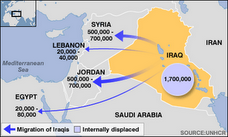
The civil war in Iraq has stranded 2 million Iraqi refugees in neighboring countries - and Washington says that up to 7,000 of them may be resettled in the United States this year. But which ones?

During a recent trip to the Middle East, I talked with many refugees who seemed to deserve resettlement in the United States, but may never get it. Even though they have been brutalized by the factional fighting in Iraq, the U.S. government might label them "supporters of terrorism."

Here is how it happens. After the United Nations or another non-governmental agency determines that a person has a "well-founded fear of persecution" in his or her country of origin, the refugee is interviewed by officials from the U.S. Department of Homeland Security. The screening includes detailed questions to make sure all of the anti-terrorism provisions of the USA Patriot Act and the Real ID Act are met.

This is understandable - but there is a flaw in the laws.

The definition of who provides "material support" to terrorists is unreasonably broad. There have been several legislative attempts to fix it, but the provisions still stand, largely unchanged, preventing resettlement of Iraqis like these three I met in February and March. (Read whole article by clicking above for details.)

....Over the past year, I traveled to half a dozen countries in Africa and Asia and saw bona fide refugees barred from entering the U.S. because of obstacles that seem similarly absurd. But the U.S. government bears special responsibility for the war in Iraq, so the mindless application of "material support" provisions to Iraqi victims of terrorism would be particularly deplorable.

The 7,000 Iraqi refugees to be resettled this year in the United States have yet to arrive. So there is still time to pass legislation, or reform the Immigration and Nationality Act, to apply definitions that don't turn victims of terrorism into supposed terrorists themselves.

MEDICAL CARE IN IRAQ DETERIORATING EVEN FURTHER


The International Committee of the Red Cross recently issued an alarming assessment of the medical conditions in Iraq. It described the situation as a crisis, with sick and injured Iraqis waiting for treatment in understaffed health care facilities. Others are too afraid to seek help because many doctors and hospitals have become targets of the insurgents....


also....

Dr Omar al-Khattab fled Iraq just over a year ago after receiving death threats. At that time, he was working at Balad General Hospital, 50km north of Baghdad. "I had to leave my home, my work and my salary so now I'm living here jobless and am just barely surviving," he said during an interview inside an almost bare apartment in the Al-Qudsiya suburb of Damascus.
"In my hospital alone, of five surgeons only one remains. We were three orthopaedics but now there are none, and only 25 per cent of the resident doctors remain." According to the Iraqi Ministry of Health and UN statistics, Khattab is one of 18,000 Iraqi doctors and health care professionals who have fled the war-torn country since the US-led invasion began in March 2003. In 2003, there were 34,000 registered health care workers in Iraq. Al-Khattab said: "I know at least 10 other Iraqi doctors just here in Al-Qudsiya who have left because of death threats or the overall security situation."
A general practitioner who was a resident in the surgical department at his hospital, al-Khattab is now living off his meagre savings and unable to return to his country. He fills his days by offering his services to other Iraqi refugees who cannot afford health care in Syria. It is also how he maintains his expertise while assisting some of what he estimates to be 50,000 Iraqis in his neighbourhood.