Friday, June 15, 2007

IRANIAN INFLUENCE IN AFGHANISTAN

By Alastair Leithead BBC News, Herat, western Afghanistan

There is more power in Herat than the locals need. The pylons get smaller and smaller as they disappear in a long, straight line, across the wide-open, windswept desert, through the heat haze and over the horizon to Iran.
In the electricity sub-station just outside of Herat, western Afghanistan, there's the loud hum of power - Iranian power.
More electricity reaches Herat than the city can use, but the industrial park just across the road from the Nato military base is putting it to good use.

Small plastic bottles of fizzy orange juice shuffle along the conveyor belt to be labelled and packed - the building is noticeably Iranian in design and the markings on the machinery show exactly which country helped these Afghan businessmen.
The camels grazing outside cautiously cross the fast, straight, asphalt road - one of the best roads in Afghanistan stretching the 120km to the border. Soon a railway line will link Afghanistan to Europe, or so boasts the Iranian government. "We are one of the major donors in Afghanistan," said Mohammad Bahrami, Iranian ambassador to Kabul.

The frontier runs for hundreds of kilometres and here, near the border post, both sides eye each other suspiciously from old mud forts and new wooden observation posts.

The intelligence reports that we get from our agents in Iran say some weapons come into Afghanistan....and US bases are springing up along the border. Given the fragile international relations between the US and Iran, there is a much bigger political reason to fight for influence in Afghanistan.

Afghan opium is smuggled between the gaps between observation towers to fuel Iran's four million addicts, and there's increasing concern about what is now travelling in the opposite direction. "The intelligence reports that we get from our agents in Iran say some weapons come into Afghanistan," said Rahmatullah Safi, the border commander for western Afghanistan. "The weapons which the enemies use these days such as Kalashnikov, rocket-propelled grenades, heavy machine guns, hand grenades, explosives - they are not coming from the sky, these definitely are coming from across the border.

"In Iraq the insurgency developed and they got more and more sophisticated. I believe we are seeing the same thing in Afghanistan, but fortunately they are still quite a long way behind Iraq." Intelligence sources say Iranian agencies, but not necessarily the government, are talking to the Taleban and that weapons are on the move. ....But the Iranian ambassador dismisses the allegations of supplying weapons: "Strongly denied. Strongly denied and we are ready to make that clear," he says.

Beautiful, ancient Herat with its huge citadel towering over the old city and its famous mud brick minarets has a multi-layered history of foreign powers using Afghanistan to expand their empires - to achieve their own global ambitions. Alexander the Great and Genghis Khan came here. The British fought Persia here in the 1850s when the Great Game with Russia was at its height.

....Everyone, of course, is at it - even British, European and American forces are here to protect themselves from terrorism at home - it's another bigger battle being fought in Afghanistan.
And when diplomatic games are played in other lands, it's the people who suffer - it's their lives which are caught up in someone else's war.

Wednesday, June 13, 2007

SAMARRA SHIITE MOSQUE HIT AGAIN


Mosque prior to attacks

"Advance warnings indicated that a second bombing against the al-Askariya mosque in Samarra was in the works, charged a representative of revered Shiite cleric Ayatollah Ali al-Sistani during Friday prayers.
"The authorities in charge had enough tips that the enemies of the people would blow up the tomb of the two Imams in order to hurl the people into sectarian strife,"
Sheikh Abdul-Mahdi al-Karbalaie said at the Imam al-Hussein Shrine in Karbala."


Iraqis are bracing for an explosion of sectarian violence following Wednesday morning's bombing of the Golden Mosque in Samarra, and information has begun to surface of attacks being mounted against Sunni mosques throughout the day.

The reporting is spotty, but current accounts indicate that at least one--but possibly three--Sunni mosques south of Baghdad were bombed, one in western Baghdad was set on fire, and one north of Baghdad was targeted with mortars.

Reuters reports that local police said gunmen blew up Iskandariya's Grand Mosque, completely destroying the building.

VOI, however, reports that three mosques were bombed--Grand Iskandariyah Mosque, Hiteen Mosque and Abdullah Mosque.

Monday, June 11, 2007

TIM RUSSERT'S INTERVIEW WITH COLIN POWELL

AS EXCERPTED BY SLOGGER

GEN. POWELL: (Iraq) is an extremely difficult situation. I have characterized it as a civil war even though the administration does not call it that. And the reason I call it a civil war is I think that allows you to see clearly what we’re facing. We’re facing groups that are now fighting each other: Sunnis vs. Shias, Shias vs. Shias, Sunni vs. al-Qaeda. And it is a civil war.

The current strategy to deal with it, called a surge—the military surge, our part of the surge under General Petraeus—the only thing it can do is put a heavier lid on this boiling pot of civil war stew. That’s only one part of the overall surge. The other two parts of the surge, building up Iraqi forces, military and police forces, so that they can take over responsibility for security and getting the Iraqi political leadership to understate—undertake reconciliation efforts and to do something to turn out the fire.

....But if, at the end of the day, when this civil war resolves itself, as every civil war eventually does resolve itself, one way or the other, and we see a government emerge that does represent the interests of its people, then maybe that’s the best success we can hope for, even though it might not be a government that looks exactly like, you know, a government we have—would have designed back here in Washington, D.C., or we would have designed in Philadelphia based on Jeffersonian principles. And so it’s a tough road ahead, but increasingly the burden has to rest on the Iraqis and not on the American troops.

....If we knew today—or knew then what we know today, that there were no weapons of mass destruction, I would’ve had nothing to take to the United Nations. The national intelligence estimate, which was the basis of my presentation and, by the way, was the basis of the intimation that was given to the Congress that caused them to vote a resolution of support four months before my UN presentation, we rested our case on the existence of weapons of mass destruction that were a threat to us and could be given to terrorists, making it another kind of threat to us.
I think without that weapons of mass destruction case, the justification would not have been there, even though Hussein was a terrible person, human rights abuses abounded, he was cheating on the UN food, Oil for Food program. But I think it is doubtful that without the weapons of mass destruction case, the president and Congress and the United Nations and those who joined us in the conflict—the British, the Italians, the Spanish, the Australians—would’ve found a persuasive enough case to support a decision to go to war.
*****
I never used terms such as cakewalk, and I never had any illusions about this being simply a stroll into Baghdad and then everything was going to be wonderful. But let’s go back to around 10 April of 2003. Saddam Hussein’s statue fell on the 9th, and from the 10th of April, for a month or two, everybody in the United States thought this was a terrific outcome. And it looked like it was going to work, just as the administration has said it was going to work.

We were liberators for a moment, and then we simply did not handle the aftermath. We didn’t realize we were in an insurgency when we were in an insurgency, and we watched as the ministries that we were counting on, the government ministries we were counting on to help us take over, were being burned and looted. And we didn’t respond. And we didn’t have enough troops in the ground. That’s my judgment, not the judgment of military commanders at the time, but it’s certainly my judgment, and we didn’t have enough troops on the ground.

Because once the government fell, the whole structure of government collapsed. Once the government in Baghdad came down, everything came down. And it was our responsibility then, under international law as the occupying authority as well as the liberators, to be responsible for restoring order, and we didn’t have enough troops there to restore that order nor did we have the political understanding of our obligation to restore that order.
*****
I was part of an administration that, over a period of years, had created a body of evidence and intelligence that said this is a dangerous regime. And I had no love for Saddam Hussein, as you can appreciate. For 12 years I’d been listening to, “Well, why didn’t you take him out back in 1991?” So I had no truck with this regime, and we had a steady stream of intelligence reports that suggested he was a danger.

And he became more of a danger after 9/11 when the possibility emerges that some of these terrible weapons he was working on—and let there be no doubt that he was continuing to work on these. He was continuing to hope that he could escape the boundaries of the UN sanctions and get back to making these kinds of weapons. And if you believe otherwise, I think that would be a naive belief. And so, throughout that time, we had this consistent body of evidence.

And when the president called me in and said, “I want you to go to the United Nations and make the presentation,” I didn’t blink in the slightest because I had been using that intelligence all along in my presentations and had every reason to believe it.

The problem we had in the next five days was that a product was being worked on in the White House and the NSC which was unusable. It was more a legal brief than it was an analysis.

I would’ve preferred no war because I couldn’t see clearly the unintended consequences. But we tried to avoid that war with the UN sanctions and putting increasing diplomatic and international pressure on Saddam Hussein. But when I took it to the president and said, “This is a war we ought to see if we can avoid,” I also said and made it clear to him, “If, at the end of the day, it is a war that we cannot avoid, I’ll be with you all the way.” That’s, that’s part of being part of a team. And therefore I couldn’t have any other outcome, and I had no reservations about supporting the president in war.

And I think things could’ve turned out differently after the middle of April if we had responded in a different way.

SADR, SISTANI MEET IN NAJAF, DISCUSS SECURITY MATTERS

(COURTESY OF SLOGGER) Najaf, Jun 10, (VOI)- Iraqi Shiite cleric Muqtada al-Sadr visited, on Sunday night, top Shiite cleric ayatollah Ali al-Sistani in his office in Najaf and both discussed the latest security and political developments in Iraq, a source from Sistani's office said.

"Sayyed Muqtada al-Sadr visited, today at 9:30 pm, Ayatollah Ali al-Sistani and both leaders discussed the political and security situation in the country," the source told the independent news agency Voices of Iraq (VOI). The source gave no further details. Sadr's visit to Sistani today is the first since the young Shiite cleric Sadr resurfaced two weeks ago.

Earlier on Sunday, the Shiite cleric Sadr called in a statement upon Turkey to solve all problems with Iraq peacefully. "Though Iraqi cities and territories are seen by many as lacking sovereignty because of the occupation, this should not be taken as a pretext to attack and shell cities and villages inside Iraq," Iraqi Shiite cleric Muqtada al-Sadr said in a statement received by the independent news agency Voices of Iraq (VOI).

Reminded of the Turkish stand on the U.S. invasion of Iraq in 2003, Sadr said "one day, we were pleased to hear that Turkey rejected the attack and occupation of Iraq. We were even more pleased when Turkey demanded a timetable for the pullout of the occupation from Iraq." Sadr described Turkey's stand on not backing up attacks on Iraq as a move to support the Iraqi people and not the former regime.

The Shiite cleric, who rejected the shellings, called on the Turkish nation to stop sedition between the two Muslim nations. "The Kurdish people are an indivisible part of the Iraqi population and it is our duty to defend them. Turks are also our friends whose sovereignty, security and territories should be respected," Sadr said in the statement.

Sadr expressed readiness to settle problems peacefully, among all sides, for the good of both nations. On Saturday, local residents said Turkish artillery had shelled the border villages of Dishish and Bidohi inside the Iraqi territories.

Accordingly, Iraq's foreign ministry summoned the Turkish envoy to Baghdad and gave him a letter protesting the shelling.

Sunday, June 10, 2007

Washington Post Page Two: A Longer Stay....

Nothing new on Page One.......except to estimate that it would take us a year to leave: just to get us and our stuff out. That is what happens when you occupy a country, build new huge bases, plus a palatial, tough, can stand on its own, Embassy.

Sounds like a "come from behind strategy" to me, but do the Iraqi's want us there? Recently the parliament passed a bill telling us to leave by the end of this year. Maybe, since it will take a year, it would be a good idea to get started


And, finally, can we AFFORD it?

TO LEARN THE FINANCIAL COST OF THE WAR AT THIS MOMENT, CLICK HERE It is over 433 billion last time I looked and we're borrowing money to pay for it. And, of course, the military guys are now confessing that their leadership was "out to lunch" for three years, 2004-6. Now that is encouraging. But at least it is the truth.

So, here is page two of the post article:

This is hardly the first time officials have considered troop reductions. The original U.S. war plan called for the Army to have only 30,000 troops in Iraq by fall 2003; later, top commanders planned for a drawdown in the summer of 2004. Neither option came to pass, as the military found itself engaged in a tougher and longer war in Iraq than it or the Bush administration had expected.
But officials here insist that they are now assessing the situation more soberly. For example, when Maj. Gen. Benjamin Mixon, the commander of the 25th Infantry Division, briefed reporters last month, he expressed worries about the performance of Iraqi forces and called the Iraqi government in Diyala province "nonfunctional." He also said candidly that he did not have enough soldiers in Diyala. As one officer here put it, his comments were of the sort that generals in Iraq once discussed in private but avoided stating publicly.

"I think there's a greater appreciation for complexity," said Lt. Col. Brad Brown, a crisis manager for the 1st Cavalry Division, which is overseeing operations in Baghdad.

Officials now dismiss the 2004-06 years -- when Gen. George W. Casey Jr. was in command -- as a fruitless "rush to transition," as one senior defense official here put it. "The idea was, 'As they stand up, we'll stand down,' " he said. That phrase has been all but banished from the Green Zone, as has the notion of measuring U.S. progress in Iraq by the number of Iraqi troops trained or by changes in U.S. casualty counts.

"We had previously 'transitioned' ourselves into irrelevance, and the whole thing was going to hell in a handbasket," a senior official commented in an e-mail.

Top military officials even say that Iraq's elections in December 2005 only deepened sectarian divides and contributed to the outbreak of a low-grade civil war in Baghdad last year. "We wanted an election in the worst way, and we got one in the worst way," one U.S. general here said.

Another major difference is that U.S. officials, both political and military, say they are more willing to take chances than before. The clearest gamble was the decision in January to move U.S. troops off big, isolated bases and into 60 small, relatively vulnerable outposts across Baghdad. However, the risk-taking also includes reaching out to people once declared enemies of the United States, such as Sadr, the Shiite cleric. "Some people say he might be ready to negotiate behind the scenes," Odierno said in an interview.

In addition, commanders will be forced to lean heavily in coming months on Iraqi security forces, whose performance has been mixed at best. The U.S. strategy in Baghdad of "clear, hold and build" calls for clearing neighborhoods of enemy forces, then holding them with a sustained military presence while reconstruction efforts get underway. Yet by itself, the United States does not have enough troops to "hold," so that mission must be executed by Iraqis.

"My nightmare -- the thing that keeps me up at night -- is a failure of Iraqi security forces, somehow, catastrophically, mixed with a major Samarra-mosque-type catastrophe," Maj. Gen. Joseph F. Fil Jr., commander of the 1st Cavalry Division, said last week, referring to the February 2006 bombing of a mosque in Samarra that sparked renewed civil strife.

Even as they focus on the realities in Iraq, officials here are also keeping an eye on Washington politics. Despite the talk in the U.S. capital that Petraeus has only until September to stabilize the situation in Iraq, some officers here are quietly suggesting that they really may have until Jan. 20, 2009 -- when President Bush leaves office -- to put the smaller, revised force in place. They doubt that Bush will pull the plug on the war or that Congress will ultimately force his hand.

Such timing matters because, despite some tactical success in making some Baghdad neighborhoods safer, officials here believe the real test of the U.S. troop increase will be its ability to create space over time for political accommodation among rival Iraqi factions. Officers agree that hasn't happened yet -- at least not significantly enough to make a difference in Washington.

Friday, June 8, 2007

Christian Science Monitor Suggests Shiite State in Iraq

A two-part Monitor series on the rise of Shiite Muslims in the Middle East reveals a subtle tactic among the sect's radical leaders: Don't confront Sunni rivals but rather find common cause. If they succeed, it may reshape the region, especially in Iraq, where this intra-Muslim conflict now plays out in daily bombings.
The new Shiite message was recently delivered by Iraq's powerful cleric, Moqtada al-Sadr, who emerged from months of hiding - perhaps in Iran - to avoid the American military surge. In late May, he told followers in a mosque sermon: "I want to say now that the blood of Sunnis is forbidden to everyone."
Then on Tuesday, the fiery young Mr. Sadr demonstrated his heavy political influence in Iraq's parliament. His bloc of legislators joined up with Sunni lawmakers to pass a resolution that requires the government to seek parliamentary permission before asking the United Nations to extend the mandate of US-led forces in Iraq. That mandate ends Dec. 31. Up to now, Prime Minister Nouri al-Maliki and his moderate Shiites in government have simply sought UN approval on their own.
Sadr's message came as his allies in Shiite Iran began talks with the United States to seek a solution for Iraq's war. Together, Iran and the Iraqi cleric are soft-pedalling any notion of Shiites seeking a strong regional role. They say they seek Muslim unity, driven by mutual resistance to Israel and to outsiders such as the US. A similar message can be heard from Iran's proxy group in Lebanon, Hizbullah.
But is their goal really to achieve Shiite dominance in the Middle East, anchored by creation of the first Arab Shiite state in Iraq? (Iran is not Arab.) Or do they simply want to prevent the kind of Sunni dominance that has marked the region for centuries? (Sunni supremacy was particularly cruel in Iraq under Saddam Hussein.)
If indeed Iran and Sadr now truly want mutual respect with Sunnis, then the path toward peace in Iraq may become easier. But if the current Iraq war is really about securing Shiite dominance, starting with control of Baghdad, then the Americans face difficult decisions ahead on troop levels or, perhaps, withdrawal.
That is why it is crucial for the Maliki government to quickly accommodate many of the political demands of Iraq's Sunni minority, such as sharing the nation's oil wealth.
Iran's intentions remain unclear. It steams ahead with nuclear enrichment that can lead to atomic blackmail in the region, but it also sends emissaries to the Sunni-dominated states like Saudi Arabia to appease any fears of Iran's rising influence.
One sign of Iran's motives may lie in the recent revival of its Center for Rapprochement of Islamic Schools of Thought. The purpose of this Shiite outpost in Tehran is to persuade Sunnis worldwide that any theological differences between the two sects are small compared with the larger goal of Muslim unity.
With their historical sense of victimization, such a missionary message is difficult for Shiites. But if old resentments can be forgotten and old offenses forgiven - which Islam teaches - then a Sunni-Shiite accommodation may emerge.
So far, the ongoing violence in Iraq doesn't point to such sectarian peace soon.

SCHORR SPEAKS UP ON BASES IN IRAQ

New White House plan: Keep US troops in Iraq permanently.

Permanent bases will damage America's image in the Middle East.

Washington - President Bush used to be fond of saying that American troops would stay in Iraq as long as needed and not a day longer. He isn't saying that anymore.

The new word from the White House is that American troops would be stationed in Iraq permanently on the "Korean model." The analogy is a little strained. The United States has helped to mend the rift between North and South Korea since 1953. But South Korea has had no internal insurgency to worry about.

The plan for permanent bases in Iraq must have been long in the making. The president ignored a recommendation of the Baker-Hamilton Commission that he state that America seeks no permanent bases in Iraq. At one point last year, the Senate and House passed an amendment to the military-spending bill banning the establishment of permanent bases in Iraq. The bill went to conference and then the ban on bases, adopted by both chambers, mysteriously disappeared.

The building of four bases along with a gigantic new American embassy in the Green Zone on the Tigris River has been moving along rapidly. The bases will have runways two miles long to accommodate the largest American planes. The Balad base north of Baghdad covers 14 square miles. Another base is planned for the area that was ancient Babylon.

The new embassy, which will be the largest American mission in the world, will be complete with swimming pool and commissary. Retired General Anthony Zinni has said that permanent bases are "a stupid idea." He said that they will damage America's image in the whole region.

These huge installations must be intended for more than Iraqi stabilization. Former President Jimmy Carter said in a speech in February of last year that "the reason we went into Iraq was to establish a permanent military base in the Gulf region." And few are missing the point that bases in Iraq will keep American might on Iran's doorstep.

• Daniel Schorr is a senior news analyst at National Public Radio.

Thursday, June 7, 2007

A NEW GOVERNMENT COALESCING IN IRAQ?

....Az-Zaman devoted its front page to the news regarding the formation of a new political front, led by Iyad 'Allawi, aiming to challenge, and possibly replace, the current Maliki government. Az-Zaman (international edition) said that al-Maliki complained that the new front represents a “conspiracy,” woven in “a foreign capital” and intent on executing a “coup” against the current government and the “political process” in Iraq.

Furthermore, the newspaper quoted Sami al-'Askari, a Maliki advisor, as saying that the Prime Minister discussed the matter of the 'Allawi front with Talabani and Barazani during a recent visit to Kurdistan.

Pro-government al-Mada also discussed the prime minister’s statements. The paper quoted Maliki as warning the “conspirators” that “the era of coups d’état has passed with the (departure of) the previous regime” and that “there is no place for conspiracies.”

In parallel to these fiery political statements, Maliki and other high-level members of the ruling establishment have been insinuating that their political opponents are involved in illicit activities, and are threatening to “reveal” incriminating information about them.

Pan-Arab al-Sharq al-Awsat reported today on al-Maliki announcing that “domestic and regional parties” are involved in the sabotage of the Iraqi oil infrastructure. Al-Maliki also warned that the government “may find itself compelled” to name the parties in such activities.
Also, in a speech given to Iraqi generals and reported by al-Mada and Az-Zaman, Maliki made links between the plots that are allegedly woven against him and “terrorism” in Iraq, and called on the army to prevent the conspirators from undermining the political process. “These people (the ‘accused’ in Maliki’s statements remain unidentified, but easily identifiable) have crossed the stage of conspiracies to the stage of disrupting security and supporting terrorism,” the Prime Minister said, according to al-Mada.

Back to the 'Allawi front, contrary to al-Mada's report yesterday predicting the downfall of the nascent alliance, Az-Zaman published a story today indicating that 'Allawi’s “front” is alive and well, and expanding.

The newspaper said that it was informed by sources in Cairo that Tariq al-Hashimi (the Iraqi vice-President and leader of the Islamic Party, one of the main constituents of 'Allawi’s coalition) informed the Egyptian president that “numerous political parties in Iraq are ready to announce a broad, moderate front aiming to salvage the situation in Iraq.”

Another spokesman of the Islamic Party told Az-Zaman that the new coalition is intended to “oppose sectarianism.” Futhermore, the paper added that talks are being held with the Shi'a Fadhila party and the Sadrist Current to join the anti-Maliki front. A leader in the Islamic Party told the newspaper that “the Sadrist Current is the closest movement to the ideas we adopt.”

In addition to 'Allawi’s parliamentary list, and several Sunni parties, the new anti-Maliki coalition is rumored to include Kurdish parties that are opposed federalism and to the mainstream Kurdish leadership, as well as several smaller parties and independent deputies. The “front” may also include a Kurdish politician -– Arshad Zibari -– who was a minister in Saddam’s administration. Az-Zaman added that Zibari, who enjoys a measure of popular support in Nineveh, had organized pro-Saddam Kurdish militias and fought many battles against the forces of Barazani and Talabani during Saddam’s rule.

It is also worthy to mention that Az-Zaman’s coverage of the anti-Maliki coalition was restricted to the London-based international edition of the publication and did not figure in the Iraq edition. As a general rule, news items that are deemed “polemical” or critical of powerful parties and politicians often get left out from the Baghdad print.

Wednesday, June 6, 2007

FOLLOW THE MONEY (OIL): TWELVE BENCHMARKS

1. January 2003: The Wall Street Journal reported that representatives from Exxon Mobil Corp., ChevronTexaco Corp., ConocoPhillips and Halliburton, among others, were meeting with Vice President Cheney's staff to plan the post- war revival of Iraq's oil industry.

2. March 2003: Iraqi Oil Ministry was one of the few structures the invading forces protected from looters in the first days of the war.

3. April 2003: During the initial assault on Baghdad, soldiers set up forward bases named Camp Shell and Camp Exxon.

4. May 22, 2003: President Bush signed Executive Order 13303 providing full legal immunity to all U.S. oil companies doing business in Iraq in order to facilitate the country's "orderly reconstruction."

5. November 2003: McKee (ConocoPhillips executive who is overseeing Iraqi oil industry) quietly ordered a new plan for Iraq's oil. The drafting would be overseen by a "senior adviser," Amy Jaffe, who ....now works for James Baker, the former Secretary of State, whose law firm serves as counsel to both ExxonMobil and the defense minister of Saudi Arabia. The plan, written by State Department contractor BearingPoint, was guided, says Jaffe, by a handful of oil-industry consultants and executives.

6. March 2004: Iraq's interim constitution, the Transitional Administrative Law (TAL) passed in March 2004 by Iraq's Governing Council, sets forth that Coalition Provisional Authority laws, regulations, and orders are to remain in force after the transfer of sovereignty unless a duly enacted piece of legislation rescinds or amends them.

7. August 30, 2005: Bush says U.S. troops would continue fighting in Iraq in order to protect the country's vast oil fields, which he said would otherwise fall under the control of terrorist extremists.

8. February 2006-June 2006: USAID contracts with Bearing Point to draft Iraq’s oil law to provide "legal and regulatory advice in drafting the framework of petroleum and other energy-related legislation, including foreign investment".

9. March 15, 2006: Gen. John Abizaid, the Army general overseeing U.S. military operations in Iraq said the United States may want to keep a long-term military presence in Iraq to bolster moderates against extremists in the region and protect the flow of oil.

10. July 2006: U.S. Government and oil companies get a copy of the draft oil law. In September 2006 the Internation Monetary Fund and World Bank receive their copy.

11. February 2007: "Draft Hydrocarbon Law" was submitted first to the Iraqi Cabinet and then to the Iraqi Parliament (Council of Representatives) by the Cabinet.

12. April -May 2007: Defense Secretary Robert Gates and U.S. Vice President Cheney each travel separately to Baghdad to push political benchmarks and specifically the oil law.

From a Study of U.S. Influence on Iraqi Oil, by Erik Leaver, Carol and Ed Newman, Fellow Institute for Policy Studies June 4, 2007. Click above title to read full article and complete bibliography of sources.

Tuesday, June 5, 2007

Breaking News: Iraqi Lawmakers Pass Resolution That May Force End of Occupation This Year

By Raed Jarrar and Joshua Holland, AlterNet. Posted June 5, 2007.While most observers are focused on the U.S. Congress as it continues to issue new rubber stamps to legitimize Bush's permanent designs on Iraq, nationalists in the Iraqi parliament --now representing a majority of the body -- continue to make progress toward bringing an end to their country's occupation.
The parliament today passed a binding resolution that will guarantee lawmakers an opportunity to block the extension of the UN mandate under which coalition troops now remain in Iraq when it comes up for renewal in December. Prime Minister Nouri al-Maliki, whose cabinet is dominated by Iraqi separatists, may veto the measure.

The law requires that any future extensions of the mandate, which have previously been made by Iraq's Prime Minister, be approved by the parliament. It is an enormous development; lawmakers reached in Baghdad today said that they do in fact plan on blocking the extension of the coalition's mandate when it comes up for renewal six months from now.

Reached today by phone in Baghdad, Nassar al Rubaie, the head of Al-Sadr bloc in Iraq's Council of Representatives, said, "this new binding resolution will prevent the government from renewing the UN mandate without the parliament's permission. They'll need to come back to us by the end of the year, and we will definitely refuse to extend the UN mandate without conditions." Rubaie added: "there will be no such a thing as a blank check for renewing the UN mandate anymore, any renewal will be attached to a timetable for a complete withdrawal."

Without the cover of the UN mandate, the continued presence of coalition troops in Iraq would become, in law as in fact, an armed occupation, at which point it would no longer be politically tenable to support it. While polls show that most Iraqis consider U.S. forces to be occupiers rather than liberators or peace-keepers -- 92 percent of respondents said as much in a 2004 survey by the Independent Institute for Administration and Civil Society Studies -- the UN mandate confers an aura of legitimacy on the continuing presence of foreign troops on Iraq's streets, even four years after the fall of Saddam Hussein.

The resolution was initiated when a majority of Iraqi lawmakers signed a non-binding legislative petition two weeks ago that called on the Iraqi government to demand a withdrawal of all foreign troops from the country.

While the issue of the Multinational Force's (MNF) mandate has been virtually ignored by the American media, it has been a point of fierce contention in Baghdad. Last fall, just after the mid-term elections in the U.S., a coalition of Iraqi nationalists in the parliament tried to attach conditions to the extension of the mandate.

Iraqi lawmaker Jabir Habib (a Shia closely aligned with the al-Sadrist Movement), said in an interview last fall that the Iraqi Assembly had been poised to vote on the issue: "We spent the last months discussing the conditions we wanted to add to the mandate," he said, "and the majority of the Parliament decided on three major conditions. These conditions included pulling the coalition forces out of the cities and transferring responsibility for security to the Iraqi government, giving Iraqis the right to recruit, train, equip, and command the Iraqi security forces, and requiring that the UN mandate expire and be reviewed every six months instead of every 12 months."

WIDER VIEW OF BAGHDAD MAP

CLICK MAP TO ENLARGE AND SEE DETAIL

Monday, June 4, 2007

BAGHDAD MAP

CLICK TO ENLARGE MAP


U.S. ADMITS PLANNING PERMANENT MILITARY BASES IN IRAQ

The United States is constructing multiple military bases in Iraq, and a gigantic embassy in Baghdad. Even as the US Congress, media, and citizenry debate withdrawal from Iraq, indisputable evidence on the ground shows a permanent imperialistic plan for US-occupied Iraq, says Patrick Seale.

....This is a geopolitical development of the first importance. It is a clear statement that, in spite of its current difficulties in Iraq -- May was the most lethal month since 2004, with 119 U.S. soldiers killed -- the United States firmly intends to maintain control of Iraq and its vast oil reserves. Iraq’s neighbours and energy-hungry states and oil companies will take note.

On a visit to the U.S. Pacific Command in Honolulu on 31 May, Secretary of Defense Robert Gates said that the United States was looking for a "long and enduring presence" in Iraq under a mutually agreed arrangement with the Iraq government.

"The Korea model is one, the security relationship we have with Japan is another," he said. U.S. troops have been in South Korea since the end of the 1950-53 Korean War and in Japan since the end of the Second World War.

Last week, the White House spokesman Tony Snow confirmed that President George W. Bush wanted to see a lengthy U.S. troop presence in Iraq at the invitation of the host government. "The situation in Iraq, and indeed, the larger war on terror, are things that are going to take a long time," he said.

....In the years since the invasion, there have been numerous journalistic accounts of mammoth bases the United States has built and continues to expand. There is the giant Al-Balad base covering 14 square miles some 40 miles north of Baghdad, formerly the Iraqi Air Force Academy. There is the even bigger Al-Asad (in al Anbar) base covering 19 square miles; the Al-Tallil base (Ali Air in Nasiriyah) ; the Al-Sarq (sic: Al Saqr or Rasheed/CampFalcon in Baghdad) base; the Al-Qayyarah (Q West, with 11,500 and 11,800 foot runways) base in the north, and many others. (corrections, clarifications are editor's)

Shortly after its invasion, the United Staes established 110 bases in Iraq. The present plan appears to consolidate these into 14 "enduring bases" in Iraqi Kurdistan, at Baghdad airport, in Anbar province and in the southern approaches to Baghdad.

Nor does the construction of a U.S. embassy able to house 1,000 staff on a 100 acre site on the banks of the Tigris -- the biggest U.S. embassy in the world -- point to an early U.S. disengagement from Iraq.

Patrick Seale is a leading British writer on the Middle East, and the author of The Struggle for Syria; also, Asad of Syria: The Struggle for the Middle East; and Abu Nidal: A Gun for Hire.

Sunday, June 3, 2007

U.S. WARNS TURKEY AGAINST UNILATERAL ACTION...

(as another blogger says: "He sure does have a leg to stand on!"

)By Steve Negus, Iraq correspondent, and Vincent Boland in Ankara
Published: June 3 2007 18:41 Last updated: June 3 2007 18:41

Robert Gates, the US defence secretary, on Sunday warned Turkey not to invade northern Iraq amid a build-up of Turkish forces on the border between the two countries.

There is an intense internal debate in Turkey about whether Ankara should push across the border to root out guerrillas of the Kurdistan Workers’ party (PKK), based inside the Kurdish autonomous region of northern Iraq. Turkey accuses the PKK of launching attacks inside Turkish territory.

The Turkish government, which faces a general election next month, has appeared so far to want to avoid a military incursion. But a bomb attack in Ankara two weeks ago in which six people were killed, has been blamed on Kurdish separatists and put the issue of terrorism, and Turkey’s appropriate response to it, at the top of the election agenda.

The military holds a spring offensive in the region every year, but the build-up in recent days has taken on an ominous dimension amid ever-louder rhetoric from Turkey’s senior generals about the need to crush PKK fighters.

Speaking at a security conference in Singapore, Mr Gates expressed sympathy for Turkey’s “genuine concern with Kurdish terrorism that takes place on Turkish soil”.

However, he added that the US hoped that there “would not be a unilateral military action across the border into Iraq”.

Saturday, June 2, 2007

DISPLACED IRAQIS: THE PRICE OF "PERMANENT OCCUPATION"

800,000 Internally Displaced Persons

There are no safe places in Iraq. Militants or insurgents find you wherever you are,” Abdul-Yassin said. “Each time we arrived in a new camp, dozens of other families arrived with us.

Most of the places are full to bursting and some of the displaced families are forced to sleep rough on the ground without tents until aid agencies can give them some protection and food. In the camp where we are staying now, we were forced to sleep in the open air for three days and drink dirty water because the aid agencies couldn’t reach us,” he said.

Contaminated Water

“Displaced families in Anbar, Baghdad, Karbala, Najaf and all the southern provinces are suffering from a shortage of potable water,” a spokesperson for the Iraq Aid Association (IAA) said. “Some are drinking contaminated water and children can be seen nearly starving, requiring urgent water and food.” The UNHCR report confirmed the above, adding that there was an urgent need for shelter, food and non-food supplies, as well as jobs. Aid agencies say they face difficulties accessing IDPs many of whom face severe water shortages.

Unemployment

Unemployment remains the main cause of growing poverty among IDPs, according to Professor Jamal Obeidi, a displacement expert from Baghdad University and an analyst in the Ministry of Displacement and Migration. “If at least one person from each [displaced] family was working, they would have been earning money and been able to buy food for their families, despite the insecurity. The lack of jobs has put these families in the worst conditions,” Obeidi said. Income and employment are reported as priority issues for 65 percent of IDPs, according to the UN-affiliated International Organisation of Migration (IOM).


Lack of Food

Forty seven percent of displaced families in Iraq have no access to the national food programme, according to the country’s Ministry of Trade and the UNHCR. “Lack of security has prevented families getting to warehouses and many others have moved to southern provinces which have been tardy in registering the newly displaced. Some areas cannot cope and lack food to give to the population,” said Maruan Muhannad, a senior official in the Ministry of Trade. Obeidi recommended to the Ministry of Trade that it organise convoys to deliver food parcels directly to IDPs in displacement areas. “They could take the warehoused food which has no owner, fill a convoy and deliver directly to such families.” “Our children are sick because they do not receiving enough food. They are eating badly because we cannot get our share of the national food programme since we got displaced a year ago and have lost our documents,” said May Kareem, 34, a displaced mother of three who lives on the outskirts of the capital. “We cannot get food and cannot leave our place. If the government really wants to help, they could deliver food parcels to us,” she said.

INTERNALLY DISPLACED PERSONS BY LOCATION (ROSE 50% IN 2006)

Northern Provinces 741,900
Central Provinces 450,000
Southern Provinces 716,500
Total 1,908,400

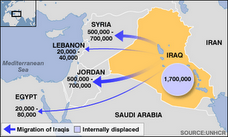
IRAQI REFUGEES

1,200,000 Syria (another 200,000 since these figures were quoted)
750,000 Jordan
100,000 Egypt
54,000 Iran
40,000 Lebanon
10,000 Turkey
200,000 Gulf States
175,000+ Elsewhere in World (Number in US: 6,000)

SOURCE: UNITED NATIONS

IRAQI CIVILIAN DEATHS

65,000 - 70,000

SOURCE: http://www.iraqbodycount.net/database/

Dancewater also reports: "Figures provided by the Lancet study suggest that 50 percent of all violent deaths of Iraqi children under 15 in that same period (March 2003 through June 2006) were due to coalition airstrikes." Since April, 2003, Turse reports, the U.S. has dropped at least 59,787 pounds of cluster bombs in Iraq, a type of weapon Human Rights Watch(HRW) termed "the single greatest risk civilians face with regard to a current weapon that is in use."

Addition: This is a summary of what was said by UNHCR spokesperson Jennifer Pagonis – to whom quoted text may be attributed – at the press briefing, on 5 June 2007, at the Palais des Nations in Geneva.

The situation in Iraq continues to worsen, with more than 2 million Iraqis now believed to be displaced inside Iraq and another 2.2 million sheltering in neighbouring states. Calls for increased international support for governments in the region have so far brought few results, and access to social services for Iraqis remains limited. Most of the burden is being carried by Jordan and Syria.

Inside Iraq, some 85 percent of the displaced are in the central and southern regions. Most of those displaced are from Baghdad and surrounding districts. Since February last year, an estimated 820,000 people have been displaced, including 15,000 Palestinians who have nowhere to go.

Individual governorates inside Iraq are becoming overwhelmed by the needs of the displaced. At least 10 out of the 18 governorates have closed their borders or are restricting access to new arrivals. UNHCR is receiving disturbing reports of regional authorities refusing to register new arrivals, including single women, and denying access to government services. Many displaced have been evicted from public buildings. Combined with the general lack of resources, this has led to a growing number of impoverished shanty towns. The UN Assistance Mission in Iraq (UNAMI) and WFP indicate that at least 47 percent of the displaced have no access to official food distribution channels.

The number of Iraqis fleeing to neighbouring countries remains high. According to government figures, some 1.4 million Iraqis are now displaced in Syria, up to 750,000 in Jordan, 80,000 in Egypt and some 200,000 in the Gulf region. Syria alone receives a minimum of 30,000 Iraqis a month.

Recognition rates of Iraqis in various countries outside the region, particularly in Europe, remain low. UNHCR repeats its call for all borders to remain open to those in need of protection.
UNHCR is rapidly expanding its operations and presence in the region, but the magnitude of the crisis is staggering. We now have 300 staff working full time on Iraqi displacement. They are based in Syria, Jordan, Lebanon, Turkey, Geneva and in Iraq itself. Since the beginning of the year, our offices in surrounding countries have registered more than 130,000 Iraqi refugees. By the end of May, UNHCR had interviewed some 7,000 of the most vulnerable Iraqis and sent their dossiers to potential resettlement countries for their further assessment and action. We urge these countries to make rapid decisions and facilitate the departure of those most in need. Resettlement, however, remains an option for only a few of the most vulnerable Iraqis. Our goal is to provide up to 20,000 Iraqi resettlement cases to governments this year.

Analysis of detailed statistics show that in Syria alone, about 47,000 of the 88,447 refugees registered since the beginning of this year are in need of special assistance. About a quarter of them require legal or protection assistance, including many victims of torture. Nearly 19 percent have serious medical conditions. UNHCR has opened two community outreach centres in Damascus and will shortly open two more. Food and medical aid is being provided to the most vulnerable. We are also working with an increasing number of local and international partners who are helping with health, education, counselling and vocational training.

Two international UNHCR staff are working in Erbil and another is scheduled to go to Baghdad when the security situation permits. These international staff are reinforcing more than 20 local UNHCR staff in seven locations in Iraq. Our goal is to provide basic assistance and shelter to some 300,000 uprooted Iraqis inside the country by the end of this year. This, however, is just a fraction of the overall needs. UNHCR legal aid centres in 18 governorates have provided advice to over 10,700 displaced Iraqis. By the end of 2007 we also plan to provide essential medical/health, food and individual assistance to 50,000 of the most vulnerable Iraqis in neighbouring countries.