Sunday, April 29, 2007

MORE ON GEORGE TENET'S BOOK & 60 MINUTES


.
.
.
.
.
.
.
.http://www.cbsnews.com/sections/i_video/main500251.shtml?id=2739654n (WATCH IT)
Tenet opens with a scene that was to turn out prescient. As he entered the West Wing at 7:30 a.m. on Sept. 12, 2001, he writes, he encountered Richard Perle, chairman of the president’s Defense Policy Board Advisory Committee.

“Iraq has to pay a price for what happened yesterday. They bear responsibility,” Tenet quotes Perle as saying.

As Tenet tells it, the CIA spent great amounts of energy and time trying — futilely, as it would turn out — to rein in the determination of Vice President Dick Cheney, Deputy Defense Secretary Paul Wolfowitz and others to use the Sept. 11 attacks to justify removing Saddam from power, which they had failed to do during the Persian Gulf War of 1991.

As early as Bush’s first meeting at Camp David with his top advisers on the weekend after the attacks, Wolfowitz “was fixated on the question of including Saddam in any U.S. responses,” Tenet writes.

Thereafter, the National Security Council staff held regular meetings on Iraq in which discussion proceeded on the assumption that Saddam would be ousted. The confidence in that outcome was so high that sometimes, debate centered on details like whose portrait would be put on the country’s new currency, Tenet says.

“I didn’t pay enough attention to the gathering storm,” Tenet writes, blaming himself for not having done enough to stem the tide of sentiment to take out Saddam whatever the justification.
Bush is depicted as having been steamrollered by more ideological members of his administration. At one NSC meeting, Bush’s questions and body language led Tenet to conclude that “the President seemed less inclined to go war than many of his senior aides!”

Tenet reserves his harshest words for Cheney, who comes across as Machiavellian, ideological and surrounded by a coterie of overly self-confident advisers. But Tenet offers unflattering assessments of numerous other top Bush aides, as well.

Secretary of State Condoleezza Rice, then the national security adviser, is painted as insecure and almost naive in some sections. At times, she strikes Tenet as incompetent; at others, she appears duplicitous. Overall, she is depicted as never being quite up to the task. Rice’s deputy at the time, Stephen Hadley, is portrayed as a mirror of his boss, but with an extra gloss of arrogance.

Douglas Feith, the undersecretary of defense for policy, comes in for a scorching review. To Tenet, no one else in the administration was so captive to the core beliefs of Wolfowitz and other neoconservative thinkers as Feith, to such an extent that he refused to brook any alternative interpretation of events.

And in characterizations certain to rankle some quarters of the administration, particularly the Defense Department, Tenet casts former Defense Secretary Donald Rumsfeld’s rival, former Secretary of State Colin Powell, as sharing Tenet’s principled doubts about the strategy for war.

SAUDI KING DECLINES TO RECEIVE IRAQI LEADER

By Robin Wright Washington Post Staff Writer
Sunday, April 29, 2007; Page A19

In a serious rebuff to U.S. diplomacy, King Abdullah of Saudi Arabia has refused to receive Iraqi Prime Minister Nouri al-Maliki on the eve of a critical regional summit on the future of the war-ravaged country, Iraqi and other Arab officials said yesterday.

BUT..........Iran to attend key Iraq meeting

April 29, 2007

Iran will attend a conference of key powers including the United States this week that will focus on stabilising Iraq, a meeting Baghdad said might be a turning point for regional cooperation in easing the violence.

Iraq's Foreign Minister Hoshiyar Zebari said there's a "high possibility" arch foes Tehran and Washington will hold bilateral talks at the May 3-4 conference in Egypt, although not necessarily at the ministerial level.

US Secretary of State Condoleezza Rice, who will attend the conference in the Red Sea resort of Sharm el-Sheikh, said she will not rule out the possibility of meeting directly with Iran's foreign minister, Manouchehr Mottaki.

http://www.smh.com.au/news/World/Iran-to-attend-key-Iraq-meeting/2007/04/29/1177787971184.html

A Failure in Generalship

(excerpt is last section of his full article and the photo is courtesy of Raising Kaine) http://www.armedforcesjournal.com/2007/05/2635198
"Yingling's comments are especially striking because his unit's performance in securing the northwestern Iraqi city of Tal Afar was cited by President Bush in a March 2006 speech and provided the model for the new security plan under way in Baghdad. He also holds a high profile for a lieutenant colonel, having attended the Army's elite School for Advanced Military Studies.The most insightful examination of failed generalship comes from J.F.C. Fuller's "Generalship: Its Diseases and Their Cure." Fuller was a British major general who saw action in the first attempts at armored warfare in World War I. He found three common characteristics in great generals — courage, creative intelligence and physical fitness." LOLITA C. BALDOR, THE ASSOCIATED PRESS

The Generals We Need: Lt. Col. Paul Yingling
The need for intelligent, creative and courageous general officers is self-evident. An understanding of the larger aspects of war is essential to great generalship. However, a survey of Army three- and four-star generals shows that only 25 percent hold advanced degrees from civilian institutions in the social sciences or humanities. Counterinsurgency theory holds that proficiency in foreign languages is essential to success, yet only one in four of the Army's senior generals speaks another language. While the physical courage of America's generals is not in doubt, there is less certainty regarding their moral courage. In almost surreal language, professional military men blame their recent lack of candor on the intimidating management style of their civilian masters. Now that the public is immediately concerned with the crisis in Iraq, some of our generals are finding their voices. They may have waited too long.

Neither the executive branch nor the services themselves are likely to remedy the shortcomings in America's general officer corps. Indeed, the tendency of the executive branch to seek out mild-mannered team players to serve as senior generals is part of the problem. The services themselves are equally to blame. The system that produces our generals does little to reward creativity and moral courage. Officers rise to flag rank by following remarkably similar career patterns. Senior generals, both active and retired, are the most important figures in determining an officer's potential for flag rank. The views of subordinates and peers play no role in an officer's advancement; to move up he must only please his superiors. In a system in which senior officers select for promotion those like themselves, there are powerful incentives for conformity. It is unreasonable to expect that an officer who spends 25 years conforming to institutional expectations will emerge as an innovator in his late forties.

If America desires creative intelligence and moral courage in its general officer corps, it must create a system that rewards these qualities....
Iraq is America's Valmy. America's generals have been checked by a form of war that they did not prepare for and do not understand. They spent the years following the 1991 Gulf War mastering a system of war without thinking deeply about the ever changing nature of war. They marched into Iraq having assumed without much reflection that the wars of the future would look much like the wars of the past. Those few who saw clearly our vulnerability to insurgent tactics said and did little to prepare for these dangers. As at Valmy, this one debacle, however humiliating, will not in itself signal national disaster. The hour is late, but not too late to prepare for the challenges of the Long War. We still have time to select as our generals those who possess the intelligence to visualize future conflicts and the moral courage to advise civilian policymakers on the preparations needed for our security. The power and the responsibility to identify such generals lie with the U.S. Congress. If Congress does not act, our Jena awaits us.

Saturday, April 28, 2007

Ex-C.I.A. Chief, in Book, Assails Cheney on Iraq

.....Mr. Tenet largely endorses the view of administration critics that Mr. Cheney and a handful of Pentagon officials, including Paul D. Wolfowitz and Douglas J. Feith, were focused on Iraq as a threat in late 2001 and 2002 even as Mr. Tenet and the C.I.A. concentrated mostly on Al Qaeda.

Mr. Tenet describes helping to kill a planned speech by Mr. Cheney on the eve of the invasion because its claims of links between Al Qaeda and Iraq went “way beyond what the intelligence shows.”

“Mr. President, we cannot support the speech and it should not be given,” Mr. Tenet wrote that he told Mr. Bush. Mr. Cheney never delivered the remarks.

Mr. Tenet hints at some score-settling in the book. He describes in particular the extraordinary tension between him and Condoleezza Rice, then national security adviser, and her deputy, Stephen J. Hadley, in internal debate over how the president came to say erroneously in his 2003 State of the Union address that Iraq was seeking uranium in Africa.

He describes an episode in 2003, shortly after he issued a statement taking partial responsibility for that error. He said he was invited over for a Sunday afternoon, back-patio lemonade by Colin L. Powell, then secretary of state. Mr. Powell described what Mr. Tenet called “a lively debate” on Air Force One a few days before about whether the White House should continue to support Mr. Tenet as C.I.A. director.

“In the end, the president said yes, and said so publicly,” Mr. Tenet wrote. “But Colin let me know that other officials, particularly the vice president, had quite another view.”

He writes that the controversy over who was to blame for the State of the Union error was the beginning of the end of his tenure. After the finger-pointing between the White House and the C.I.A., he wrote, “My relationship with the administration was forever changed.”

Tuesday, April 24, 2007

COVER-UP OF TILLMAN AND LYNCH INCIDENTS AT HIGHEST LEVELS

Ranger Alleges Cover-Up in Tillman Death
Tillman Family, Lynch Address House Panel
By SCOTT LINDLAW and ERICA WERNER
AP
WASHINGTON (April 24) - An Army Ranger who was with Pat Tillman when he died by friendly fire said Tuesday he was told by a higher-up to conceal that information from Tillman's family. "I was ordered not to tell them," U.S. Army Specialist Bryan O'Neal told the House Committee on Oversight and Government Reform.

He said he was given the order by then-Lt. Col. Jeff Bailey, the battalion commander who oversaw Tillman's platoon. Pat Tillman's brother Kevin was in a convoy behind his brother when the incident happened, but didn't see it. O'Neal said Bailey told him specifically not to tell Kevin Tillman that the death was friendly fire rather than heroic engagement with the enemy. "He basically just said, 'Do not let Kevin know, he's probably in a bad place knowing that his brother's dead,'" O'Neal said. He added that Bailey made clear he would "get in trouble" if he told. Kevin Tillman was not in the hearing room when O'Neal spoke.

In earlier testimony, Kevin Tillman accused the military of "intentional falsehoods" and "deliberate and careful misrepresentations" in portraying Pat Tillman's death in Afghanistan as the result of heroic engagement with the enemy instead of friendly fire.

There was additional testimony from Jessica Lynch, then an Army private, who was badly injured when her convoy was ambushed in Iraq. She was subsequently rescued by American troops from an Iraqi hospital but the tale of her ambush was changed into a story of heroism on her part. Still hampered by her injuries, Lynch walked slowly to the witness table and took a seat alongside Tillman's family members. "The bottom line is the American people are capable of determining their own ideals of heroes and they don't need to be told elaborate tales," Lynch said.

54.433 CASUALTIES AND BLOGGER CHALLENGES "HOPELESSLY MISBEGOTTEN POLITICAL" STRATEGY

Home
US Iraq casualties rise to 54,433
Media
By Michael Munk
US military occupation forces in Iraq suffered at least 169 combat casulties in the week ending April 24, as total casualties reached at least 54,433.

Empire Notes concludes his weekly blog commentary today:

even if it (The United States) had the best intentions in the world, there is almost certainly nothing that it can do about that fragmentation now. Instead, it should limit itself to learning one of the key lessons from Vietnam: if your enterprise is hopelessly misbegotten politically, it cannot be saved by technical fixes.
Rahul Mahajan is a student at the University of Texas, Austin

Monday, April 23, 2007

Lee Iaccoca Has Had Enough


Had Enough?

Am I the only guy in this country who's fed up with what's happening? Where the hell is our outrage? We should be screaming bloody murder. We've got a gang of clueless bozos steering our ship of state right over a cliff, we've got corporate gangsters stealing us blind, and we can't even clean up after a hurricane much less build a hybrid car. But instead of getting mad, everyone sits around and nods their heads when the politicians say, "Stay the course."

Saturday, April 21, 2007

CHANGE IN LEADERSHIP

....President Bush has warmed to strategies and ideas he once rejected to turn around the violence and chaos in Iraq - such as sending thousands more troops to the country in an effort to calm Baghdad. His new crop of Iraq leaders bypasses ideologues and loyalists in favor of professionals with previous experience in Iraq and war zones.

"None of them are particularly ideological or were associated with the original public push for the war," said Kurt Campbell, chief executive officer of the nonpartisan, centrist Center for a New American Security. The new leaders "are probably quietly appalled that we find ourselves in the situation that we do in Iraq," Campbell said.

http://www.msnbc.msn.com/id/17351284/ Olbermann: Condi's inaccurate historical comparison (SEE IT)

Baghdad Burning reports that: 'The World Health Organisation reported on Tuesday that Iraq’s hospitals are so dysfunctional that “70 percent of all critically injured patients with violence-related wounds die in emergency and intensive care units due to a shortage of competent staff and a lack of drugs and equipment”.'

ADMINISTRATION OFFICIALS LOOTED THE US AND IRAQ TREASURIES: ETHICAL MALFEASANCE


When Bremer Ruled Baghdad

When President Bush announced "Mission Accomplished," and the end of the war in May 2003, he also said we would help the citizens of Iraq rebuild their country. "Now that the dictator's gone," he stated, "we and our coalition partners are helping Iraqis to lay the foundations of a free economy."

....Bremer granted himself the authority to run the government ministries, appoint Iraqi officials and award contracts for reconstruction. Next he fired 500,000 Iraqis, most of them soldiers, but pink slips also went out to many doctors, nurses, teachers and other public employees as well.

For the most part, the CPA financed its activities with billions of dollars that belonged to the Iraqis. On May 22, 2003, a UN Security Council passed a resolution that directed the proceeds from Iraqi oil to be placed in a Development Fund for Iraq, and the CPA was granted authority to control the fund and decide which profiteers would get contracts. During the year that Bremer controlled the purse strings, the Iraqi Development Fund received $20.2 billion, including $8.1 billion from the UN's oil-for-food program, $10.8 billion from Iraqi oil, and the rest from repatriated funds, vested assets and donations.

The CPA accounting system was cash and carry and a steady stream of cash was flown into Bagdad from the US. Inspector General, Stuart Bowen later said that he knew of one $2 billion flight. A report released by the House Government Reform Committee in February 2007, shows that in the 13 months that Bremer ruled, from May 2003 to June 2004, the Federal Reserve Bank in New York shipped nearly $12 billion in a cash to Iraq. One can only imagine the Bank service charges associated with these shipments because to accomplish this feat, according to the Democratic chairman of the Reform Committee, Henry Waxman, the cash weighed 363 tons and the Bank had to count and pack 281 million individual bills, including more than 107 million $100 bills, and then load them onto wooden pallets to be shipped to Bagdad on C-130 cargo planes.

....In June 2004, the Government Accounting Office estimated that more than $1 billion in had been wasted due to illegal overcharges by contractors since the war began. A later audit by the Iraqi government found that as much as $1.27 billion was lost to accounting irregularities between June 2004 and February 2005.

....Not surprisingly, Cheney's Halliburton remained the top profiteer under Bremer's rule. A July 23, 2004, audit conducted by Bowen, showed the company had received 60% of all contracts paid for with Iraq money, including 5 no-bid contracts worth $222 million, $325 million, $180 million, and the last 2 together totaled $194 million for the last two. In comparison, the audit showed that the CPA awarded only 2% of the reconstruction contracts to Iraqi companies. In one example of blatant fraud, an audit found that Halliburton was charging for more than 41,000 meals a day for soldiers when only about 14,000 were served.

....Senator Robert Byrd said he was outraged over the inability to monitor CPA spending. "There is no reason why any arm of the executive branch charged with making such significant spending decisions," he said, "should not be working directly with Congress." "Former Bush Administration officials," he warned fellow Senators, "are even setting up consulting firms to act as middlemen for contractors hoping to take part in the bonanza." "Are we turning the U.S. Treasury into a grab bag for favorite campaign contributors to be financed at taxpayer expense?" he asked.

The answer was yes, and what a grab bag it was. Media reports revealed that Bush's ex-campaign manager and Feith's former law partner had set up consulting firms to profit off the war by lining up contracts for clients through their partners in crime within the CPA. Other reports revealed that contracts worth $407 were awarded to a firm called Nour that was formed less than 2 months after the war began. The names linked to the profits from Nour, among many others, included former Secretary of Defense, William Cohen, Ahmad Chalabi via a $2 million kickback, his nephew Salam Chalabi as the attorney handling the deal, and the money trail even led to the First Brothers, Marvin and Jeb Bush. But come to find out, Doug Feith the ringleader on the ground in Washington, had awarded a batch of no-bid contracts to a favored company the month before the war began for the purpose of controlling the media in post-war Iraq.

The favored companies enjoyed a fraud-free-all. For instance, Halliburton said it had lost over $60 million worth of government property including trucks, office furniture and computers. Inspector Bowen reported that 6,975 items valued at $61.1 million were lost, and in June 2005, the Defense Contract Audit Agency reported that the Halliburton had overcharged or presented questionable bills for close to $1.5 billion.
In the end, Bowen's audit concluded that "the CPA's internal controls for approximately $8.8 billion in DFI funds disbursed to Iraqi ministries through the national budget process failed to provide sufficient accountability for the use of those funds."

As of February 2007, according to Bowen, audits of the CPA have resulted in 300 criminal and civil investigations, 5 arrests and convictions, and another 23 cases are currently under prosecution at the DOJ, and he is working on 76 on-going investigations. One of the convictions involved Robert Stein, a former CPA comptroller and funding officer, who recently pleaded guilty to 5 felony counts including conspiracy, money laundering, and bribery in stealing more than $2 million of reconstruction funds and taking more than $1 million in kickbacks to rig the bids on contracts that exceeded $8 million.

....The whistleblower case against Custer Battle went to trial and a jury found that Custer had committed 37 acts of fraud and filed $3 million in false claims, and rendered a verdict with a $10 million penalty. However, the verdict was overturned by Republican appointed US District Court Judge TS Ellis III, who ruled that the CPA was not a US entity and therefore the false claims act does not apply to it. In the ruling, the judge said Custer's accusers "failed to prove that the U.S. government was ever defrauded. Any fraud that occurred was perpetrated instead against the Coalition Provisional Authority, formed to run Iraq until a government was established."

Legal experts say this ruling is great news for the CPA and contractors because from now on anyone charged with any act of fraud related to the Iraqi money doled out by the CPA in Bagdad will use it in attempt to avoid civil or criminal prosecution.
Evelyn Pringle can be reached at: evelyn-pringle@sbcglobal.net

BILL MOYERS SLAMS MEDIA'S PRE-WAR COVERAGE

Next week, PBS welcomes the triumphant return of "Bill Moyers Journal" with a 90-minute documentary "Buying the War," a sharp indictment of the media's coverage of the lead-up to the invasion of Iraq. Bill Moyers returns to PBS Wednesday night with a smackdown of the media performance leading to the Iraq war
Greg Mitchell at E&P got his hands on an advance copy, and rates the program highly:
"While much of the evidence of the media's role as cheerleaders for the war presented here is not new, it is skillfully assembled, with many fresh quotes from interviews (with the likes of Tim Russert and Walter Pincus) along with numerous embarrassing examples of past statements by journalists and pundits that proved grossly misleading or wrong. Several prominent media figures, prodded by Moyers, admit the media failed miserably, though few take personal responsibility."
Mitchell also lists some statistics Moyers cites in the show:
Number of William Safire op-eds "fanning the sparks of war" in the year before the invasion: 27
Number of front-page Washington Post stories during the same period that made the Administration's case for war: 140
Number of the 414 Iraq stories broadcast on CBS, NBC, and ABC in the six months prior to the war traced back solely to a White House source: Nearly all of them

Friday, April 20, 2007

ANOTHER NOT SO HUMOROUS SIDE OF JOHN MCCAIN?

In response to an audience question about military action against Iran, the Arizona senator briefly sang the chorus of the surf-rocker classic "Barbara Ann."
"That old, eh, that old Beach Boys song, Bomb Iran," he said in jest Wednesday, chuckling with the crowd. Then, he softly sang to the melody: "Bomb, bomb, bomb, bomb, anyway, ah ..." The audience responded with more laughter.
His quip was prompted by a man in the audience who asked: "How many times do we have to prove that these people are blowing up people now, nevermind if they get a nuclear weapon, when do we send 'em an airmail message to Tehran?"

My thoughts: Sounds like PTSD to me. Dissociating likely, decompensating from the pressures of his Iraq stance and endorsement of Bush policies.

Thursday, April 19, 2007

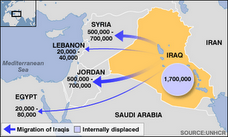
UPDATED IRAQ MAP (CLICK ON IMAGE TO ENLARGE) and UPDATED BAGHDAD MAP


2 MILLION INTERNALLY DISPLACED IRAQIS: STATEMENT OF REPRESENTATIVE OF SECRETARY GENERAL OF UN

(There are) almost 2 million internally displaced Iraqis, of whom over 700,000 have been displaced in the past 14 months. Reports indicate that internal displacement is continuing and, unless peace and stability are restored soon, the number of internally displaced persons (IDPs) will likely increase.
People are leaving their homes because of the violence in Iraq and while many have sought safety in neighboring countries – as is their right under international law many are unwilling or unable to leave their country. Although systematic data are lacking, it is likely that those who are internally displaced are even more vulnerable than refugees: IDPs are closer to the conflict which led to their displacement and the provision of humanitarian assistance inside Iraq is extremely difficult.

Wednesday, April 18, 2007

BOMBS KILL 178 IN BAGHDAD TODAY

Iraqi men evacuate a burned body from the site of a car bomb explosion at Baghdad's al-Sadriyah neighborhood.

NEWEST STATISTIC: OVER 190 KILLED

BAGHDAD (AP) - April 18, 2007 - Four large bombs exploded in mostly Shiite areas of Baghdad on Wednesday, killing at least 178 people and wounding scores - the deadliest day in the city since the start of the U.S.-Iraqi campaign to pacify the capital two months ago.

WAS JUST A "SCHOOL OF TERROR", BUT NOW A "UNIVERSITY"

Qaeda Group Says Iraq A “University of Terror” Developing its own Quds-1 Rocket?