Saturday, June 30, 2007

U.S. SOLDIERS DYING MORE WHILE COMMAND AND CONTROL IS CHALLENGED BY CIVILIAN CASUALTIES

Richard Oppel Jr., NEW YORK TIMES REPORTS ON KILLING OF FIVE GI'S in the southern Baghdad neighborhood of Dora by a huge, buried bomb. Seven were also wounded. The attack brings to 330 the number of U.S. military deaths over the past three months, including 100 so far in June, making it the deadliest period yet for the American military in Iraq.

Maj. Gen. Joseph Fil Jr., commander of the 1st Cavalry Division and in charge of Baghdad, said the coordinated attack, which included the bomb, small-arms fire and RPGs, was "very violent" and showed a level of coordination and sophistication the military hasn't often seen. These kinds of attacks are taking their toll: in the first six months of 2007, 574 service members have died, a 62 percent increase over the same period last year. Fil said the insurgents were some of the worst he's ever seen.

BAGHDAD, June 30 (KUNA) -- The Iraqi Government condemned on Saturday a US military operation in the Baghdad suburban region of Al-Sadr where up to 26 gunmen were killed. The government said in a statement that it "emphatically rejects any military operation by the Multi-National Forces in any Iraqi governorate or city without prior approval of the command of the Iraqi Military Forces or coordination with the command." It also urged the Iraqi regulars to abide by orders, made by the higher national authorities, and warned against launching attacks against civilians.The statement added that the government would seek clarification from the Multi-National Forces about the operation that was carried out in the suburban region at dawn today.Witnesses told KUNA that several civilians were killed and wounded during the operation.

A number of mosques announced that cleric Muqtada al-Sadr has postponed next week's march to Samarra. This occurred during Friday prayers, facing shouts and, occasionally, tears as worshippers reacted to the news that the July 5 march was being called off. al-Naseri, one of the leaders, told his followers at the al-Kufa mosque, “If the government is no longer able to protect citizens it has to step aside.”

We have just had allegations of a severe military attack on June 22 attack in Diyala Province, al-Khalis.........(see previous post)

Military Charges Soldiers With Murder
By HAMID AHMED, AP
Posted: 2007-06-30 05:54:22

BAGHDAD (June 30) - Two U.S. soldiers were charged with the premeditated murder of three Iraqis, while 26 people died in American raids in Baghdad's Sadr City neighborhood, the U.S. military said Saturday. The soldiers are accused of killing three Iraqis in separate incidents, then planting weapons on the victims' remains, the military said in a statement.

Fellow soldiers reported the alleged crimes, which took place between April and this month in the vicinity of Iskandariyah, 30 miles south of Baghdad, it said.The U.S. military on Saturday identified the soldiers as Staff Sgt. Michael A. Hensley from Chandler, N.C., and Spc. Jorge G. Sandoval from Laredo, Texas.Hensley is charged with three counts each of premeditated murder, obstructing justice and "wrongfully placing weapons with the remains of deceased Iraqis," the military said. He was placed in military confinement in Kuwait on Thursday.
Sandoval faces one count each of premeditated murder and placing a weapon with the remains of a dead Iraqi, a statement said. He was taken into custody Tuesday while at home in Texas, and was transferred to military confinement in Kuwait three days later, it said. Both were assigned to the 1st Battalion, 501 Infantry Regiment, 4th Brigade (Airborne), 25th Infantry Division, based at Fort Richardson, Alaska.
In Sadr City, the military said those killed were "terrorists" who attacked U.S. troops before dawn Saturday with small arms fire, rocket-propelled grenades and roadside bombs. But Iraqi police and hospital officials said all the dead were civilians killed in their homes. "Everyone who got shot was shooting at U.S. troops at the time," said Lt. Col. Christopher Garver, a U.S. military spokesman. "It was an intense firefight."
The Iraqi officials, who spoke on condition of anonymity out of security concerns, put the death toll at eight, with 20 wounded. Seventeen suspected militants also were detained in the operation, which consisted of two separate raids, the U.S. military said in a statement. American troops entered the Shiite enclave in search of militants suspected of helping Iranian terror networks fund operations in Iraq, the statement said. There were no U.S. casualties, it said.
But witnesses said U.S. forces rolled into their neighborhood before dawn and opened fire without warning."At about 4 a.m., a big American convoy with tanks came and began to open fire on houses - bombing them," said Basheer Ahmed, who lives in Sadr City's Habibiya district. "What did we do? We didn't even retaliate - there was no resistance."The raids centered on the Habibiya and Orfali districts of Sadr City, police said.
Sadr City is the Iraqi capital's largest Shiite neighborhood _ home to some 2.5 million people. It is also the base of operations for the Mahdi Army, a militia loyal to anti-American cleric Muqtada al-Sadr.
In the Shiite holy city of Najaf, a spokesman for al-Sadr condemned Saturday's raids."We reject these repeated assaults against civilians. The allegation that Mahdi Army members were the only ones targeted is baseless and wrong," said Sheik Salah al-Obaidi. "The bombing hurt only innocent civilians."The U.S. military statement said soldiers riding in armored vehicles "used proper escalation of force rules to engage four civilian vehicles." "You start with warnings and work your way up to firing on a vehicle," Garver said. "Every structure and vehicle that the troops on the ground engaged were being used for hostile intent," he said....
But according to Iraqi officials, the dead included three members of one family - a father, mother and son. Several women and children, along with two policemen, were among the wounded, they said.One of the policemen, Montadhar Kareem, said he was on night duty in the Habibiya area when the raids began."At about dawn, American troops came with tanks and began bombing houses in the area," he said."The bombing became more intense, and I was injured by shrapnel in both my legs and in my left shoulder," Kareem said from a gurney at Al Sadr General Hospital.Houses, a bakery and some other shops were damaged by fire from U.S. tanks during the operation, Iraqi officials said.
Later Saturday in northwest Baghdad's Shula neighborhood, dozens of men gathered to donate blood for the Sadr City victims."The Americans are not letting people live in peace, and there are lots of victims," said one of the donors, Murtada Abdul-Hassan.
Meanwhile in Afghanistan: An Afghan rights group has claimed that US soldiers have killed four civilian members of the same family during a raid in Nangarhar in Afghanistan. It says the soldiers also arrested 15 civilians during the pre-dawn raid which took place in Khogiani district which lies in the foothills of the provincial capital Jalalabad. Among those killed in the raid were an 85-year-old man, Mohammada Jan, two of his sons and a grandson.

Thursday, June 28, 2007

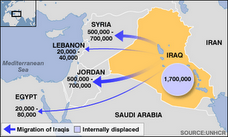
REFUGEES OVERWHELM SYRIA

When the Iraqis first came, Syrians were happy to help them but now that is no longer the case," said Ammar Qurabi of the National Organization for Human Rights (NOHR) which has monitored the effects of Iraqi refugees on Syria. "Now most people hate the refugees and are angry because food and houses are expensive and there is no work because Iraqis take the easy jobs."

WHY THE IRAQ WAR WON'T ENGULF THE MIDEAST

By Steven A. Cook, Ray Takeyh and Suzanne Maloney
June 28, 2007

WASHINGTON:Long before the Bush administration began selling "the surge" in Iraq as a way to avert a general war in the Middle East, observers both inside and outside the government were growing concerned about the potential for armed conflict among the regional powers.

Underlying this anxiety was a scenario in which Iraq's sectarian and ethnic violence spills over into neighboring countries, producing conflicts between the major Arab states and Iran as well as Turkey and the Kurdistan Regional Government. These wars then destabilize the entire region well beyond the current conflict zone, involving heavyweights like Egypt.

This is scary stuff indeed, but with the exception of the conflict between Turkey and the Kurds, the scenario is far from an accurate reflection of the way Middle Eastern leaders view the situation in Iraq and calculate their interests there.
It is abundantly clear that major outside powers like Saudi Arabia, Iran and Turkey are heavily involved in Iraq. These countries have so much at stake in the future of Iraq that it is natural they would seek to influence political developments in the country.

Yet, the Saudis, Iranians, Jordanians, Syrians, and others are very unlikely to go to war either to protect their own sect or ethnic group or to prevent one country from gaining the upper hand in Iraq.
The reasons are fairly straightforward. First, Middle Eastern leaders, like politicians everywhere, are primarily interested in one thing: self-preservation. Committing forces to Iraq is an inherently risky proposition, which, if the conflict went badly, could threaten domestic political stability. Moreover, most Arab armies are geared toward regime protection rather than projecting power and thus have little capability for sending troops to Iraq.

Second, there is cause for concern about the so-called blowback scenario in which jihadis returning from Iraq destabilize their home countries, plunging the region into conflict.Middle Eastern leaders are preparing for this possibility. Unlike in the 1990s, when Arab fighters in the Afghan jihad against the Soviet Union returned to Algeria, Egypt and Saudi Arabia and became a source of instability, Arab security services are being vigilant about who is coming in and going from their countries.

In the last month, the Saudi government has arrested approximately 200 people suspected of ties with militants. Riyadh is also building a 700 kilometer wall along part of its frontier with Iraq in order to keep militants out of the kingdom.

Finally, there is no precedent for Arab leaders to commit forces to conflicts in which they are not directly involved. The Iraqis and the Saudis did send small contingents to fight the Israelis in 1948 and 1967, but they were either ineffective or never made it. In the 1970s and 1980s, Arab countries other than Syria, which had a compelling interest in establishing its hegemony over Lebanon, never committed forces either to protect the Lebanese from the Israelis from other Lebanese. The civil war in Lebanon was regarded as someone else's fight.Indeed, this is the way many leaders view the current situation in Iraq. To Cairo, Amman and Riyadh, the situation in Iraq is worrisome, but in the end it is an Iraqi and American fight.

As far as Iranian mullahs are concerned, they have long preferred to press their interests through proxies as opposed to direct engagement. At a time when Tehran has access and influence over powerful Shiite militias, a massive cross-border incursion is both unlikely and unnecessary. So Iraqis will remain locked in a sectarian and ethnic struggle that outside powers may abet, but will remain within the borders of Iraq.

The Middle East is a region both prone and accustomed to civil wars. But given its experience with ambiguous conflicts, the region has also developed an intuitive ability to contain its civil strife and prevent local conflicts from enveloping the entire Middle East.

Iraq's civil war is the latest tragedy of this hapless region, but still a tragedy whose consequences are likely to be less severe than both supporters and opponents of Bush's war profess.

Steven A. Cook and Ray Takeyh are fellows at the Council on Foreign Relations. Suzanne Maloney is a senior fellow at Saban Center, Brookings Institution.

FAILING IN FALLUJAH

PICTURE IS OF FALLUJAH SITES NEAR HOSPITAL
Curfew-Bound Fallujah On The Boil Again
Inter Press Service By Ali al-Fadhily*
FALLUJAH, Jun 27 (IPS) - Strict curfew and tight security measures have brought difficult living conditions and heightened tempers to residents of this besieged city. The siege in this city located 60km west of Baghdad has entered its second month. There is little sign of any international attention to the plight of the city. Fallujah, which is largely sympathetic to the Iraqi resistance, was assaulted twice by the U.S. military in 2004.

The second attack in November destroyed roughly three-quarters of the city of 350,000 residents. Now, Fallujah faces assault of another kind by way of a strict curfew where people are closed in from all sides. Many people who had earlier supported the Iraqi police that works with the U.S. military, now oppose it. "We gave full support to the police force despite opposition from others to forming this force," a community leader in the city who asked to be referred to as Ahmed told IPS. "Others told us this force would only serve the occupation forces, but we accused them of being against stability and order. Unfortunately, they appeared to be absolutely right."

Cars have not been permitted to move on the streets of Fallujah for nearly a month now. A ban was also enforced on bicycles, but residents were later granted permission to use them. "Thank God and President Bush for this great favour," said Ala'a, a 34-year-old schoolteacher. "We are the only city in the liberated world with the blessing now of having bicycles moving freely in the streets." On May 21 U.S. and Iraqi forces imposed a security crackdown on the city following continuing attacks.
Local non-governmental organisations such as the Iraqi Aid Association (IAA) have told reporters that the U.S. military is not allowing them access to the city. "We have supplies but it is impossible to reach the families. They are afraid to leave their homes to look for food, and children are getting sick with diarrhoea caused by the dirty water they are drinking," IAA spokesman Fatah Ahmed told reporters. "We have information that pregnant women are delivering their babies at home as the curfew is preventing them from reaching hospital."
Medical services are inaccessible to most because the hospital is located on the other side of the Euphrates River from the rest of the city. Extra security checkpoints have severely hampered movement within the city, and most businesses have closed. A year ago the local police cut mobile phone services.

The curfew is also restricting residents' ability to go out and find much needed supplies in the markets. Residents told IPS that there is on average only two hours electricity in 24 hours. Residents say they are up against killing prices. "Now they are killing us with a new weapon," a young man with a mask covering his face told IPS. "A jar of gas costs 20 dollars and a kilo of tomatoes costs 1.50 dollar, and people cannot go to work."

"U.S. snipers on rooftops are enjoying themselves watching us walk around to find a bite of food for our families," 55-year-old Hajji Mahmood told IPS. "They laugh at us and call us names. They should know Fallujah is still the same city that kicked them away three years ago." Life seems completely paralysed with little sign of movement under a blazing sun, with temperatures up to 45 degrees (centigrade). "We are sweating to death because some of us went to those damned elections," said a 40-year-old lawyer, speaking with IPS on condition of anonymity, referring to the Jan. 30, 2005 elections.

"The wise men told us not to, but we believed those crooks of the Islamic Party who promised to make things better," he said. Many people in the city accuse the Islamic Party supportive of the U.S. of leading the 'security plan' in al-Anbar province where Fallujah is located. A local political analyst offered his views to IPS via the Internet, on condition of anonymity. "I find it rather strange that to control a city under the flag of providing citizens with peace and prosperity, you deprive them of all signs of life," he said. "Arab, Muslim and all international community leaders should be ashamed of themselves for not even talking about this crime.

"Nonetheless, U.S. leaders are just buying more time towards more failure that they hope will magically turn into success. I am hopeless of any peace in Iraq as long as the democrats sold their fight cheap to the Bush administration." Lt-Col Azize Abdel-Kader, a Defence Ministry official who coordinates security operations in al-Anbar said the curfew -- which runs from 6 pm until 8 am -- was necessary to maintain security. "It is a temporary curfew and we hope it can soon end," he told reporters in Baghdad last week. "We are looking into ways to let aid agencies enter Fallujah but it is too dangerous for the time being."

(*Ali, our correspondent in Baghdad, works in close collaboration with Dahr Jamail, our U.S.-based specialist writer on Iraq who travels extensively in the region)

Wednesday, June 27, 2007

VILLAGE DISPUTES STORY OF DEADLY ATTACK BY U.S. FORCES

Village disputes story of deadly attack

The US military said the dead were al-Qaeda gunmen

A group of villagers in Iraq is bitterly disputing the US account of a deadly air attack on 22 June, in the latest example of the confusion surrounding the reporting of combat incidents there. The BBC's Jim Muir investigates:

On 22 June the US military announced that its attack helicopters, armed with missiles, engaged and killed 17 al-Qaeda gunmen who had been trying to infiltrate the village of al-Khalis, north of Baquba, where operation "Arrowhead Ripper" had been under way for the previous three days. The item was duly carried by international news agencies and received widespread coverage, including on the BBC News website.

But villagers in largely-Shia al-Khalis say that those who died had nothing to do with al-Qaeda. They say they were local village guards trying to protect the township from exactly the kind of attack by insurgents the US military says it foiled. The incident highlights the problems the news media face in verifying such combat incidents in remote areas

They say that of 16 guards, 11 were killed and five others injured - two of them seriously - when US helicopters fired rockets at them and then strafed them with heavy machinegun fire. Minutes before the attack, they had been co-operating with an Iraqi police unit raiding a suspected insurgent hideout, the villagers said.


They added that the guards, lightly armed with the AK47 assault rifles that are a feature of practically every home in Iraq, were essentially a local neighbourhood watch paid by the village to monitor the dangerous insurgent-ridden area to the immediate south-west at Arab Shawkeh and Hibhib, where the al-Qaeda leader Abu Musab al-Zarqawi was killed a year ago.

Here is the (U.S.) version of the incident issued by the US-led Multinational Forces on 22 June:


"Coalition Forces attack helicopters engaged and killed 17 al-Qaeda gunmen southwest of Khalis, Friday.
"Iraqi police were conducting security operations in and around the village when Coalition attack helicopters from the 25th Combat Aviation Brigade and ground forces from 3rd Brigade Combat Team, 1st Cavalry Division, observed more than 15 armed men attempting to circumvent the IPs and infiltrate the village.
"The attack helicopters, armed with missiles, engaged and killed 17 al-Qaeda gunmen and destroyed the vehicle they were using."

This is the story as told to the BBC by several local villagers:


At around 2am on Friday morning, the village guards were at their usual base in an unfinished building on the edge of the Hayy al-Junoud quarter about 2km (1.2 miles) south-west of al-Khalis village centre. They were surprised when a convoy of Iraqi police suddenly turned up, headed by the commander of the Khalis emergency squad, Col Hussein Kadhim.

The police told them they were about to raid a suspect house in nearby al-Akrad Street and asked for the village mukhtar (headman) to accompany them. The Mukhtar of Hayy al-Junoud, Jassem Khalil, and his brothers Abbas and Ali, went with the police. Some of the other guards, about half altogether, also offered to go along. The raid turned out to be a false alarm - there was nothing suspicious at the house in question.

But as the police and guards began to return, the police received an urgent radio message from the Joint Operations Centre saying that US helicopters were about to raid the area.

The police disappeared immediately. But before the guards could even get to their own car, they were hit by a rocket strike by American helicopters which suddenly appeared overhead. So too were the remainder of the guards, still at their base in the unfinished building nearby.

The rocket attacks were followed by a prolonged period of strafing by heavy machinegun fire from the helicopters. "It was like a battlefront, but with the fire going only in one direction," said a local witness. "There was no return fire".


When frightened villagers ventured out at first light, they found 11 of the village guards dead, some of their bodies cut into small pieces by the munitions used against them. Those who survived with injuries were Bashir (an off-duty policeman), Alwan Hussein, Abu Ra'id, Salam, and Saif Khalil, the son of Abbas Khalil who died.

The families of those who died are seeking a meeting with the head of the al-Khalis town council. They are incensed that the village guards should be described as "al-Qaeda gunmen". All but two of those killed were Shia and they have been buried at Najaf. The other two who were from the local minority Sunni community.

Sunday, June 24, 2007

CHENEY: THE DARK SIDE AND THE CONSTITUTION


.
.
.
.
.
.
.
.
.
.
.
.
.
.
.Just past the Oval Office, in the private dining room overlooking the South Lawn, Vice President Cheney joined President Bush at a round parquet table they shared once a week. Cheney brought a four-page text, written in strict secrecy by his lawyer. He carried it back out with him after lunch.In less than an hour, the document traversed a West Wing circuit that gave its words the power of command. It changed hands four times, according to witnesses, with emphatic instructions to bypass staff review.

When it returned to the Oval Office, in a blue portfolio embossed with the presidential seal, Bush pulled a felt-tip pen from his pocket and signed without sitting down. Almost no one else had seen the text.

Cheney's proposal had become a military order from the commander in chief. Foreign terrorism suspects held by the United States were stripped of access to any court -- civilian or military, domestic or foreign. They could be confined indefinitely without charges and would be tried, if at all, in closed "military commissions."

"What the hell just happened?" Secretary of State Colin L. Powell demanded, a witness said, when CNN announced the order that evening, Nov. 13, 2001. National security adviser Condoleezza Rice, incensed, sent an aide to find out. Even witnesses to the Oval Office signing said they did not know the vice president had played any part.

The Post story over the next few days continues to describe Cheney undermining precious environmental protections, killing Salmon in Oregon; using his powers repeatedly to undermine even President Bush's policies (capital gains reductions vs. eliminating dividends taxes) and protecting his turf and secrecy by successfully removing himself from many levels of legally mandated oversight.

Saturday, June 23, 2007

APOCALYPSE NOW: RELIGIOUS FERVOR OVER THE END TIMES


Everyday Apocalypse in Iraq
E-mail this Juan Cole, Informed Comment, Jun 20, 2007.
(excerpt)
...shrines are revered in Iran, as well as by the Shiites in Iraq, and President Mahmud Ahmadinejad is a millenarian especially devoted to the cult of the Twelfth Imam. Sentiments of the Iranian public are also being stirred by these attacks (not to mention Hizbullah in Lebanon, and Shiites in Pakistan, Bahrain, Saudi Arabia and elsewhere, who increasingly blame the US for the desecrations). Religious politics is politics, and the US is being wrongfooted in a major way here.

The signs of the coming of the Twelfth Imam in Shiite tradition are as follows:

'The Sign consists of the following traits: the people will neglect prayer, squander the divinity which is conferred on them, legalize untruths, practice usury, accept bribes, construct huge edifices, sell religion to win this lower world, employ idiots, consult with women, break family ties, obey passion and consider insignificant the letting of blood. Magnanimity will be considered as weakness and injustice as glory, princesses will be debauched and ministers will be oppressors, intellectuals will be traitors and the reader of the Koran vicious. False witness will be brought openly and immorality proclaimed in loud voices.

A word of promise will be slander, sin and exaggeration. The sacred Books will be ornate, the mosques disguised, the minarets extended. Criminals will be praised, the lines of combat narrowed, hearts in disaccord and pacts broken. Women, greedy for the riches of this lower world, will involve themselves in the business of their husbands; the vicious voices of the man will be loud and will be listened to. The most ignoble of the people will become leaders, the debauched will be believed for fear of the Evil they will cause, the liar will be considered as truthful and the traitor as trustworthy. They will resort to singers and musical instruments...and women will horse ride, they will resemble men and the men will resemble women.

The people will prefer the activities of this lower-world to those of the Higher-World and will cover with lambskin the hearts of wolves."Muqtada al-Sadr has alleged that the entire point of the US invasion and occupation of Iraq was to keep this decadent situation in place and to forestall the coming of the Mahdi by planting military bases around Iraq and the Persian Gulf. He says that the US Pentagon has an enormous file on the Mahdi. In orther words, the US and militant Sunni Arabs are felt by many Iraqi Shiites to be playing the role of Dajjal or "Anti-Christ", a figure whose purpose is to forestall the coming of the Imam Mahdi.

Shiite tradition holds that the Mahdi will come together with the Return of Christ, and that the returned Christ will kill the Dajjal. (Ironically, some of the US troops fighting the Shiite millenarians may be evangelicals who also believe that the Return of Christ is near; Iraq is a wonderland for apocalytpicism).
In a videotaped meeting with Ayatollah Javadi-Amoli in Tehran, Ahmadinejad discussed candidly a strange, paranormal experience he had while addressing the United Nations in New York last September.
He recounts how he found himself bathed in light throughout the speech. But this wasn't the light directed at the podium by the U.N. and television cameras. It was, he said, a light from heaven.
According to a transcript of his comments, obtained and translated by
Joseph Farah's G2 Bulletin,
"On the last day when I was speaking, one of our group told me that when I started to say 'Bismillah Muhammad,' he saw a green light come from around me, and I was placed inside this aura," he says. "I felt it myself. I felt that the atmosphere suddenly changed, and for those 27 or 28 minutes, all the leaders of the world did not blink. When I say they didn't move an eyelid, I'm not exaggerating. They were looking as if a hand was holding them there, and had just opened their eyes – Alhamdulillah!"

Sunday, June 17, 2007

KURDS AND TURKS: WILL THEY OR WON'T THEY

Sunday, June 17, 2007
JUAN COLE'S BLOG: INFORMED CONSENT

Kurds and Turks: Will they or Won't They?

....the atmosphere in Ankara (Turkey's capital) is of extreme anger about the Iraqi Kurdistan Regional Government giving safe haven to guerrillas of the Kurdish Worker's Party (PKK). I mean livid.
It should be remembered that leftist PKK guerrillas are thought to be responsible for the deaths of 35,000 persons in Turkey since 1984. In other words, PKK has done 10 times more damage to Turkey than al-Qaeda has done to the United States. And, that is not even taking into account that Turkey is a fourth the size of the US, so you could say 40 times more. In the piece just linked, F. Stephen Larrabee estimates that "Since January 2006, PKK cross-border raids from safe havens in northern Iraq have led to roughly 600 deaths, many of them members of the Turkish security forces."
In other words, the Kurdistan Regional Government is playing the Taliban to the PKK's al-Qaeda, from the point of view of the Turkish government. It is harboring 5,000 PKK fighters. Turkey has a strong and impressive military tradition and does not take casualties in its security forces lightly.
The alleged recent border incursion by several hundred Turkish troops 2 miles into Iraq in hot pursuit of PKK fighters probably did occur....Such incursions are also opportunities for intelligence gathering.
The order for the border incursion probably did not come from that high up. The Turkish commanders at the border have enough authority, I was told, to do a little hot pursuit like that without prior clearance if they feel it is important for military reasons.
I brought up with several observers my nightmare, that the Kurdistan Regional Government in Iraq will certainly annex Kirkuk later this year, and that there may be as a result clashes between the Kurds and the Turkmen minority. Iraqi Turkmen, some 800,000 strong, have been adopted by the Turks of Turkey as sort of little brothers. I can't imagine the Turkish public standing for a massacre of Turkmen, and hundreds of thousands of people in the street could force Buyukanit to act decisively.
My colleagues universally agreed that the potential was there for an escalation of the crisis under such conditions. No one said I was exaggerating the risks. One former official who is an expatriate said that before he arrived in Ankara last week, he did not know just how angry people there were over this issue. He is now convinced that the situation is serious.
Partlow points out that if Turkey did take on the Iraqi Kurds over the haven they have given the PKK, the US would likely be forced to support Turkey, a NATO ally acting against a terrorist threat.
....I think the situation in the north has entered a phase of continual crisis in which things could spiral out of control at any moment. I continue to be just amazed that no one in authority in Iraq is taking any steps to try to avert such a crisis. I earlier suggested a partion of Kirkuk province before the referendum as a way of defusing the tensions. But it seems like that the referendum will be held in the whole province and that the whole of it will go to Kurdistan. Turkish Foreign Minister Abdullah Gul has said that this development would be a cause for war in and of itself. The train wreck continues to unfold.

BLAIR KNEW POST-WAR PREPARATIONS WERE INADEQUATE

Nicholas Watt, political editorSunday June 17, 2007

The Observer
Tony Blair agreed to commit British troops to battle in Iraq in the full knowledge that Washington had failed to make adequate preparations for the postwar reconstruction of the country.


In a devastating account of the chaotic preparations for the war, which comes as Blair enters his final full week in Downing Street, key No 10 aides and friends of Blair have revealed the Prime Minister repeatedly and unsuccessfully raised his concerns with the White House. He also agreed to commit troops to the conflict even though President George Bush had personally said Britain could help 'some other way'.

....Sir David Manning, now Britain's ambassador to Washington, says: 'It's hard to know exactly what happened over the post-war planning. I can only say that I remember the PM raising this many months before the war began. He was very exercised about it.'

Manning reveals that Blair was so concerned that he sent him to Washington in March 2002, a full year before the invasion. Manning recalls: 'The difficulties the Prime Minister had in mind were particularly, how difficult was this operation going to be? If they did decide to intervene, what would it be like on the ground? How would you do it? What would the reaction be if you did it, what would happen on the morning after? 'All these issues needed to be thrashed out. It wasn't to say that they weren't thinking about them, but I didn't see the evidence at that stage that these things had been thoroughly rehearsed and thoroughly thought through.'
On his return to London, Manning wrote a highly-critical secret memo to Blair. 'I think there is a real risk that the [Bush] administration underestimates the difficulties,' it said. 'They may agree that failure isn't an option, but this does not mean that they will avoid it.'

FAILURE AT THE HIGHEST LEVELS: JOINT CHIEFS OF STAFF


Responsibility for the disaster of Iraq lies not only with the President of the United States, but also with the Joint Chiefs of Staff. The president needs expert and candid military counsel. Not yes-men in uniform....
Excerpted from article in Boston Globe by Andrew J. Bacevich June 17, 2007
History will render this judgment of Pace, who succeeded General Richard B Myers as chairman in September 2005: As U. S. forces became mired ever more deeply in an unwinnable war, Pace remained a passive bystander, a witness to a catastrophe that he was slow to comprehend and did little to forestall. If the position of JCS chair had simply remained vacant for the past two years, it is difficult to see how the American military would be in worse shape today.
Softening history's verdict will be this fact: Long before Pace arrived on the scene the JCS had established a well-deserved reputation as one of the most ineffective institutions in Washington. Dissatisfaction with the Joint Chiefs dates virtually from the moment in 1947 when Congress passed the legislation creating it. Trying to fix the JCS soon became a cottage industry. The widespread unhappiness with Pace's performance, culminating in his de facto firing, affirms that these various reforms have failed.
Expectations that a permanent mechanism for providing military advice could improve the quality of civilian decision-making inspired the creation of the Joint Chiefs in the first place. After all, this had seemingly been the case during World War II, when Franklin Roosevelt had created a precursor of the modern JCS whose members had collaborated effectively with FDR in successfully directing a massive global war.
..., instead of military professionals offering disinterested advice to help policymakers render sound decisions, the history of this civilian-military relationship is one of conniving, double-dealing, and mutual manipulation. As generals increasingly played politics, they forfeited their identity as nonpartisan servants of the state. Presidents Harry Truman, Dwight D. Eisenhower, and John F. Kennedy, each for different reasons, came to see the members of the Joint Chiefs as uniformed political adversaries.
Although himself a five-star general, Eisenhower railed in private throughout his presidency about members of the Joint Chiefs conspiring to undermine his policies whenever they happened to collide with cherished interests of the military services. His Farewell Address, warning that the "military-industrial complex" could well "endanger our liberties or democratic processes," amounted to a tacit admission that as commander-in-chief he had lost control of his generals.
....In his now-classic 1997 book, "Dereliction of Duty," Colonel H. R. McMaster, an active-duty army officer who has served in Iraq with considerable distinction, described how a civil-military relationship based on mutual dishonesty and suspicion reached its pre-Iraq low-point during the US intervention in Vietnam. In his blistering indictment, McMaster charged the Joint Chiefs of Staff of the early 1960s -- the "five silent men," he called them -- with complicity in the lies and deceptions that produced the debacle of that war.
During Operation Desert Storm, (Colin Powell) ...convinced President George H. W. Bush to end the ground war after just 100 hours; he insisted that U. S. forces after the Cold War retain the capability to fight two large-scale conventional wars simultaneously; he questioned the wisdom of humanitarian intervention in the Balkans and elsewhere; and he torpedoed President Bill Clinton's efforts to permit gays to serve openly in the military.
The ultimate testimony to Powell's influence lies in the "Powell Doctrine" -- the general himself defining the criteria for when and how the United States would fight its wars. By 1993, with the Clinton administration stumbling as it left the gate, the JCS chairman had established himself as perhaps the dominant figure in Washington, a situation that persisted until Powell's second two-year term expired that fall and he retired.
Having learned from Powell's tenure that a talented, high-powered JCS chairman can produce big-time political headaches, the administrations of Bill Clinton and George W. Bush have opted for officers who could be counted on not to make waves. They have done so by selecting anti-Powells to serve as JCS chairmen -- officers who, whatever their other admirable qualities, have possessed few of the attributes that made Powell so formidable. Since 1993, the position of JCS chairman has been filled by a succession of colorless, compliant generals -- honorable and good soldiers to the man, but none demonstrating anything approaching Powell's smarts, flair, and shrewdness. Mediocrity can be a cruel word, but as a description of those who have succeeded Colin Powell as the nation's top military officer, it is apt.
When Donald Rumsfeld served as defense secretary, silent assent became an absolute requirement, as army chief of staff Eric Shinseki learned, to his chagrin. When Shinseki testified, during the run-up to the Iraq invasion, that occupying the country might require many more troops than were available, Rumsfeld and his deputy Paul Wolfowitz went out of their way to humiliate and discredit the general for having the temerity to venture an independent opinion. The message to the senior officer corps was clear: those interested in getting ahead were expected to toe the party line.

Pace exemplifies this breed. Only once during his time as chairman has Pace asserted himself -- and that, somewhat bizarrely, was to express his view that homosexuality is immoral. Apart from that uncharacteristic outburst, he has loyally accommodated himself to whatever the boss has wanted, even to calamitous policies that have done immeasurable harm not only to the country but to the armed services to which he has devoted his life.
Perhaps symbolic of that willingness to accommodate, even as Iraq continued to unravel, Pace found time to write a pre-sentencing letter on behalf of convicted perjurer Lewis "Scooter" Libby, assuring the trial judge that Libby is a selfless team player. Pace's involvement in an issue so tinged with partisan overtones was at the very least unseemly, and raises troubling questions about his priorities, if not about the hierarchy of his loyalties.
Let there be no mistake: primary responsibility for the failure of US policy in Iraq lies with civilian policymakers, beginning with the president. As Mr. Bush rightly insists, at the end of the day he remains "the decider." Yet senior military advisers like Pace cannot fully absolve themselves of responsibility for the disasters that have occurred on their watch. To charge Pace with something akin to "dereliction of duty" may go too far. He has, after all, served precisely as his civilian masters wished him to serve. And yet for precisely that reason, his dismissal is richly deserved.
The armed forces deserve top-notch professional leadership. Civilian policymakers need expert military counsel, offered clearly and candidly. Yet to charge one small group of senior officers with fulfilling both functions makes it unlikely that either will be adequately performed. The dismal saga of the Joint Chiefs has demonstrated this in spades. At the highest levels a line should exist between the senior officers who advise on matters of national security policy and those expected to implement policy decisions. One way to draw that line might be to select advisers from the ranks of retired generals and admirals, independent-minded "wise men" no longer involved in running their services.
Secretary Gates has described Pace's successor as an officer of "vision, strategic insight, and integrity." No doubt similar words were spoken when Pace himself was appointed chairman, perhaps with equal sincerity.
Yet whatever personal attributes Admiral Mullen may possess -- even if he ends up being more like a Powell than another Pace -- the real problem lies with the institution over which he will preside. Six decades of trying to fix the Joint Chiefs of Staff have produced little positive effect. Further tinkering will only waste more money and, alas, more lives.
The JCS lies beyond salvaging. Before you build a new house, you tear the old one down. For the Joint Chiefs of Staff, it's wrecking-ball time. A chairman possessing vision, strategic insight, and integrity ought to be the first to acknowledge that.
Andrew J. Bacevich, professor of history and international relations at Boston University, is editor of "The Long War: A New History of U.S. National Security Policy Since World War II," published this month by Columbia University Press.

Saturday, June 16, 2007

IRAQ ARCHAEOLOGICAL AND ARTISTIC CULTURE ENDANGERED BY TARGETED ASSASSINATIONS

By Afif Sarhan in Baghdad and Firas Al-Atraqchi in Damascus
Iraq's archaeological and artistic culture is in danger of being wiped out due to a lack of protection and targeted assassinations, a group of archaeologists and artists have told Al Jazeera.
According to figures from the ministry of culture, 18 archaeologists and researchers have been killed since late 2005. Fuad Rassi, an Iraqi archaeologist and professor of antiquities at Baghdad University, said: "We are unable to protect important historical sites and the remaining books and parchments documenting Iraq's culture have been stolen from local libraries." Rassi also said the intimidation and murder of archaeologists since the 2003 US-led invasion has impeded the country's research into, and preservation of, millennary culture. He said: "There aren't archaeologists remaining in Iraq because most of them have been killed and the others have fled from the violence. Our situation is getting critical in Iraq. Archaeologists and artists are being targeted by militias and insurgents."

In May 2003, the UN Security Council passed resolution 1483 which stressed "the need for respect for the archaeological, historical, cultural, and religious heritage of Iraq, and for the continued protection of archaeological, historical, cultural, and religious sites, museums, libraries, and monuments".

But Lamia Al-Gailani-Werr, an Iraqi archaeologist and member of the Iraqi State Board of Antiquities and former adviser to the Iraqi Reconstruction and Development Council, says the looting and destruction of Iraq's sites has continued despite international awareness. "The destruction of Iraq's heritage is leaving a bitter legacy for future generations," she told Al Jazeera previously.

Meanwhile, Baghdad authorities are facing growing challenges as they pursue artifacts smugglers or provide protection to endangered sites. Iraq's ministry of culture says its employees are unable to continue their research or visit existing sites and excavations due to security risks. Mariam Muhammad, a senior official at the ministry, said: "We are seeing the history of Iraq being lost and because of violence we cannot move to afford protection. Professionals in the area are being killed on [a] daily basis and our employees are afraid to leave their homes."

Haythem Abdel-Lattef, 56, an archaeologist who was working at the Babylon heritage sites south of Baghdad in 2006, chose to leave Iraq seven months ago after one of his sons was kidnapped. He said: "I received telephone calls which threatened me, saying that if I didn't flee Iraq within one week, they were going to kill my sons and wife. I packed and after two days I arrived in Jordan where I'm facing difficult financial conditions as I had to leave everything behind in Baghdad." After arriving in Jordan, he said he received word that two of his colleagues who had been excavating new sites near Babylon were killed.

The culture ministry's Muhammad said that in addition to the threat to Iraq's archaeological resources, many of Iraq's leading authors, artists and singers have been persecuted and killed - victims of the country's sectarian violence. In February 2007, the Iraqi Artist's Association said 75 singers had been killed between March 2003 and December 2006. The association also said 80 per cent of the country's singers had fled the country.

But those that braved the bullets and continued to perform have often paid the price. In November, Youssef Jabry, 20, was beheaded for singing Western songs at parties and wedding receptions while popular comedian Walid Hassan, who often mocked post-invasion politics, was shot to death as he drove through Baghdad. In December, Muttashar Al-Soudani, Iraqi soap opera icon, was gunned down by unknown assailants as he collected his pension in Baghdad.
In January, Wissam Abdallah, 25, an up-and-coming actor, was killed by unknown fighters.

Abdallah's mother, Salua Abdel-Kader, 48, told Al Jazeera her son was killed because he was "seen as a sinner" by Islamic factions which have gained power in post-war Iraq. He said: "I lost my son who was an actor because he was performing at the theatre and for this reason considered a betrayer of Islam." His murder and the pursuit of other actors and singers have sowed fear among the performing arts community in and around Baghdad.

Abdel-Kader said: "Our lives have been inside the walls of our houses. The maximum entertainment that you can find today is going to your neighbour for a [cup of] tea and nowadays, even this diversion sometimes isn't possible because of the spread sectarian violence. "We cannot visit museums, theatres or libraries because art in Iraq today has been considered a sin by extremists."

Since May 2007, three Baghdad artists were killed, including Khalil al-Zahawi, renowned Islamic calligrapher. A senior member of the Calligraphy and Arabesque Art Department at the Nineveh Institute of Fine Arts told Al Jazeera that he believed conditions in Iraq have made it a graveyard for artists and innovation. Speaking on the condition of anonymity because he has been threatened with death, he said Islamic extremism has forced many of his colleagues to either flee Iraq or go undercover. "Only Islamic art is permissible because the new Islamic groups like al-Qaeda feel there is no importance to us. Those of us who paint portraits, for example, are seen as sinners," he said in a small unfurnished apartment in Damascus. "Those that cannot leave Iraq because of financial constraints find themselves going hungry - hungry and fearful that the next bullet or sword is destined for them."

One such Iraqi artist was condemned to death by Islamist groups for belonging to "a Zionist organisation". Maher Harbi, a Christian artist in northern Iraq, managed to survive two successive assassination attempts before fleeing to Syria. He had been a member of an association of Shia, Sunni, Christian and secular artists who met once every week to discuss holding ateliers and exhibits. But Mohammed Alban, a photographer for al-Sharqiya satellite channel, wasn't so lucky. His assassination led to the dissolution of the Mosul chapter of the artists'association in late 2006.

Muhammad Khalid Lattif, actor and member of the Iraqi Artists Association who survived an assassination attempt, said: "Even if we work, how can we put in practice or expose our projects to Iraqis? There aren't places [to exhibit] because everywhere is under security and as soon as we reach to wherever the place is, we are going to be killed.

"We will cry all together for this sad reality threatening our culture."

Friday, June 15, 2007

IRANIAN INFLUENCE IN AFGHANISTAN

By Alastair Leithead BBC News, Herat, western Afghanistan

There is more power in Herat than the locals need. The pylons get smaller and smaller as they disappear in a long, straight line, across the wide-open, windswept desert, through the heat haze and over the horizon to Iran.
In the electricity sub-station just outside of Herat, western Afghanistan, there's the loud hum of power - Iranian power.
More electricity reaches Herat than the city can use, but the industrial park just across the road from the Nato military base is putting it to good use.

Small plastic bottles of fizzy orange juice shuffle along the conveyor belt to be labelled and packed - the building is noticeably Iranian in design and the markings on the machinery show exactly which country helped these Afghan businessmen.
The camels grazing outside cautiously cross the fast, straight, asphalt road - one of the best roads in Afghanistan stretching the 120km to the border. Soon a railway line will link Afghanistan to Europe, or so boasts the Iranian government. "We are one of the major donors in Afghanistan," said Mohammad Bahrami, Iranian ambassador to Kabul.

The frontier runs for hundreds of kilometres and here, near the border post, both sides eye each other suspiciously from old mud forts and new wooden observation posts.

The intelligence reports that we get from our agents in Iran say some weapons come into Afghanistan....and US bases are springing up along the border. Given the fragile international relations between the US and Iran, there is a much bigger political reason to fight for influence in Afghanistan.

Afghan opium is smuggled between the gaps between observation towers to fuel Iran's four million addicts, and there's increasing concern about what is now travelling in the opposite direction. "The intelligence reports that we get from our agents in Iran say some weapons come into Afghanistan," said Rahmatullah Safi, the border commander for western Afghanistan. "The weapons which the enemies use these days such as Kalashnikov, rocket-propelled grenades, heavy machine guns, hand grenades, explosives - they are not coming from the sky, these definitely are coming from across the border.

"In Iraq the insurgency developed and they got more and more sophisticated. I believe we are seeing the same thing in Afghanistan, but fortunately they are still quite a long way behind Iraq." Intelligence sources say Iranian agencies, but not necessarily the government, are talking to the Taleban and that weapons are on the move. ....But the Iranian ambassador dismisses the allegations of supplying weapons: "Strongly denied. Strongly denied and we are ready to make that clear," he says.

Beautiful, ancient Herat with its huge citadel towering over the old city and its famous mud brick minarets has a multi-layered history of foreign powers using Afghanistan to expand their empires - to achieve their own global ambitions. Alexander the Great and Genghis Khan came here. The British fought Persia here in the 1850s when the Great Game with Russia was at its height.

....Everyone, of course, is at it - even British, European and American forces are here to protect themselves from terrorism at home - it's another bigger battle being fought in Afghanistan.
And when diplomatic games are played in other lands, it's the people who suffer - it's their lives which are caught up in someone else's war.

Wednesday, June 13, 2007

SAMARRA SHIITE MOSQUE HIT AGAIN


Mosque prior to attacks

"Advance warnings indicated that a second bombing against the al-Askariya mosque in Samarra was in the works, charged a representative of revered Shiite cleric Ayatollah Ali al-Sistani during Friday prayers.
"The authorities in charge had enough tips that the enemies of the people would blow up the tomb of the two Imams in order to hurl the people into sectarian strife,"
Sheikh Abdul-Mahdi al-Karbalaie said at the Imam al-Hussein Shrine in Karbala."


Iraqis are bracing for an explosion of sectarian violence following Wednesday morning's bombing of the Golden Mosque in Samarra, and information has begun to surface of attacks being mounted against Sunni mosques throughout the day.

The reporting is spotty, but current accounts indicate that at least one--but possibly three--Sunni mosques south of Baghdad were bombed, one in western Baghdad was set on fire, and one north of Baghdad was targeted with mortars.

Reuters reports that local police said gunmen blew up Iskandariya's Grand Mosque, completely destroying the building.

VOI, however, reports that three mosques were bombed--Grand Iskandariyah Mosque, Hiteen Mosque and Abdullah Mosque.

Monday, June 11, 2007

TIM RUSSERT'S INTERVIEW WITH COLIN POWELL

AS EXCERPTED BY SLOGGER

GEN. POWELL: (Iraq) is an extremely difficult situation. I have characterized it as a civil war even though the administration does not call it that. And the reason I call it a civil war is I think that allows you to see clearly what we’re facing. We’re facing groups that are now fighting each other: Sunnis vs. Shias, Shias vs. Shias, Sunni vs. al-Qaeda. And it is a civil war.

The current strategy to deal with it, called a surge—the military surge, our part of the surge under General Petraeus—the only thing it can do is put a heavier lid on this boiling pot of civil war stew. That’s only one part of the overall surge. The other two parts of the surge, building up Iraqi forces, military and police forces, so that they can take over responsibility for security and getting the Iraqi political leadership to understate—undertake reconciliation efforts and to do something to turn out the fire.

....But if, at the end of the day, when this civil war resolves itself, as every civil war eventually does resolve itself, one way or the other, and we see a government emerge that does represent the interests of its people, then maybe that’s the best success we can hope for, even though it might not be a government that looks exactly like, you know, a government we have—would have designed back here in Washington, D.C., or we would have designed in Philadelphia based on Jeffersonian principles. And so it’s a tough road ahead, but increasingly the burden has to rest on the Iraqis and not on the American troops.

....If we knew today—or knew then what we know today, that there were no weapons of mass destruction, I would’ve had nothing to take to the United Nations. The national intelligence estimate, which was the basis of my presentation and, by the way, was the basis of the intimation that was given to the Congress that caused them to vote a resolution of support four months before my UN presentation, we rested our case on the existence of weapons of mass destruction that were a threat to us and could be given to terrorists, making it another kind of threat to us.
I think without that weapons of mass destruction case, the justification would not have been there, even though Hussein was a terrible person, human rights abuses abounded, he was cheating on the UN food, Oil for Food program. But I think it is doubtful that without the weapons of mass destruction case, the president and Congress and the United Nations and those who joined us in the conflict—the British, the Italians, the Spanish, the Australians—would’ve found a persuasive enough case to support a decision to go to war.
*****
I never used terms such as cakewalk, and I never had any illusions about this being simply a stroll into Baghdad and then everything was going to be wonderful. But let’s go back to around 10 April of 2003. Saddam Hussein’s statue fell on the 9th, and from the 10th of April, for a month or two, everybody in the United States thought this was a terrific outcome. And it looked like it was going to work, just as the administration has said it was going to work.

We were liberators for a moment, and then we simply did not handle the aftermath. We didn’t realize we were in an insurgency when we were in an insurgency, and we watched as the ministries that we were counting on, the government ministries we were counting on to help us take over, were being burned and looted. And we didn’t respond. And we didn’t have enough troops in the ground. That’s my judgment, not the judgment of military commanders at the time, but it’s certainly my judgment, and we didn’t have enough troops on the ground.

Because once the government fell, the whole structure of government collapsed. Once the government in Baghdad came down, everything came down. And it was our responsibility then, under international law as the occupying authority as well as the liberators, to be responsible for restoring order, and we didn’t have enough troops there to restore that order nor did we have the political understanding of our obligation to restore that order.
*****
I was part of an administration that, over a period of years, had created a body of evidence and intelligence that said this is a dangerous regime. And I had no love for Saddam Hussein, as you can appreciate. For 12 years I’d been listening to, “Well, why didn’t you take him out back in 1991?” So I had no truck with this regime, and we had a steady stream of intelligence reports that suggested he was a danger.

And he became more of a danger after 9/11 when the possibility emerges that some of these terrible weapons he was working on—and let there be no doubt that he was continuing to work on these. He was continuing to hope that he could escape the boundaries of the UN sanctions and get back to making these kinds of weapons. And if you believe otherwise, I think that would be a naive belief. And so, throughout that time, we had this consistent body of evidence.

And when the president called me in and said, “I want you to go to the United Nations and make the presentation,” I didn’t blink in the slightest because I had been using that intelligence all along in my presentations and had every reason to believe it.

The problem we had in the next five days was that a product was being worked on in the White House and the NSC which was unusable. It was more a legal brief than it was an analysis.

I would’ve preferred no war because I couldn’t see clearly the unintended consequences. But we tried to avoid that war with the UN sanctions and putting increasing diplomatic and international pressure on Saddam Hussein. But when I took it to the president and said, “This is a war we ought to see if we can avoid,” I also said and made it clear to him, “If, at the end of the day, it is a war that we cannot avoid, I’ll be with you all the way.” That’s, that’s part of being part of a team. And therefore I couldn’t have any other outcome, and I had no reservations about supporting the president in war.

And I think things could’ve turned out differently after the middle of April if we had responded in a different way.

SADR, SISTANI MEET IN NAJAF, DISCUSS SECURITY MATTERS

(COURTESY OF SLOGGER) Najaf, Jun 10, (VOI)- Iraqi Shiite cleric Muqtada al-Sadr visited, on Sunday night, top Shiite cleric ayatollah Ali al-Sistani in his office in Najaf and both discussed the latest security and political developments in Iraq, a source from Sistani's office said.

"Sayyed Muqtada al-Sadr visited, today at 9:30 pm, Ayatollah Ali al-Sistani and both leaders discussed the political and security situation in the country," the source told the independent news agency Voices of Iraq (VOI). The source gave no further details. Sadr's visit to Sistani today is the first since the young Shiite cleric Sadr resurfaced two weeks ago.

Earlier on Sunday, the Shiite cleric Sadr called in a statement upon Turkey to solve all problems with Iraq peacefully. "Though Iraqi cities and territories are seen by many as lacking sovereignty because of the occupation, this should not be taken as a pretext to attack and shell cities and villages inside Iraq," Iraqi Shiite cleric Muqtada al-Sadr said in a statement received by the independent news agency Voices of Iraq (VOI).

Reminded of the Turkish stand on the U.S. invasion of Iraq in 2003, Sadr said "one day, we were pleased to hear that Turkey rejected the attack and occupation of Iraq. We were even more pleased when Turkey demanded a timetable for the pullout of the occupation from Iraq." Sadr described Turkey's stand on not backing up attacks on Iraq as a move to support the Iraqi people and not the former regime.

The Shiite cleric, who rejected the shellings, called on the Turkish nation to stop sedition between the two Muslim nations. "The Kurdish people are an indivisible part of the Iraqi population and it is our duty to defend them. Turks are also our friends whose sovereignty, security and territories should be respected," Sadr said in the statement.

Sadr expressed readiness to settle problems peacefully, among all sides, for the good of both nations. On Saturday, local residents said Turkish artillery had shelled the border villages of Dishish and Bidohi inside the Iraqi territories.

Accordingly, Iraq's foreign ministry summoned the Turkish envoy to Baghdad and gave him a letter protesting the shelling.